



A model-based AI kill switch: an exercise in performance art
Good intentions don’t work. Mechanisms do.


How we revamped our Redleader agent to enable governed, multi-agent AI for the enterprise








At Redpanda, scaling agentic customer experience began in mid-2025 with Redleader, a single, prompt-driven agent operating across boundless Slack channels and customer interactions. If you attended Streamfest, you might remember our demo on designing Redpanda AI agents for customer replies. In short, Redleader proved that:
It served as a foundation that delivered real value. However, as adoption increased we recognized it needed more structure and controls. So, we developed a revamped Redleader—a bounded, multi-agent system running on Redpanda’s Agentic Data Plane.
In this post, we loop you in on what we changed in the product architecture and how it lets us operate Redleader at scale across our enterprise ecosystem.
Redleader now consists of multiple bounded agents that collaborate, rather than a single agent that does everything. Responsibilities are granted to specialist agents:
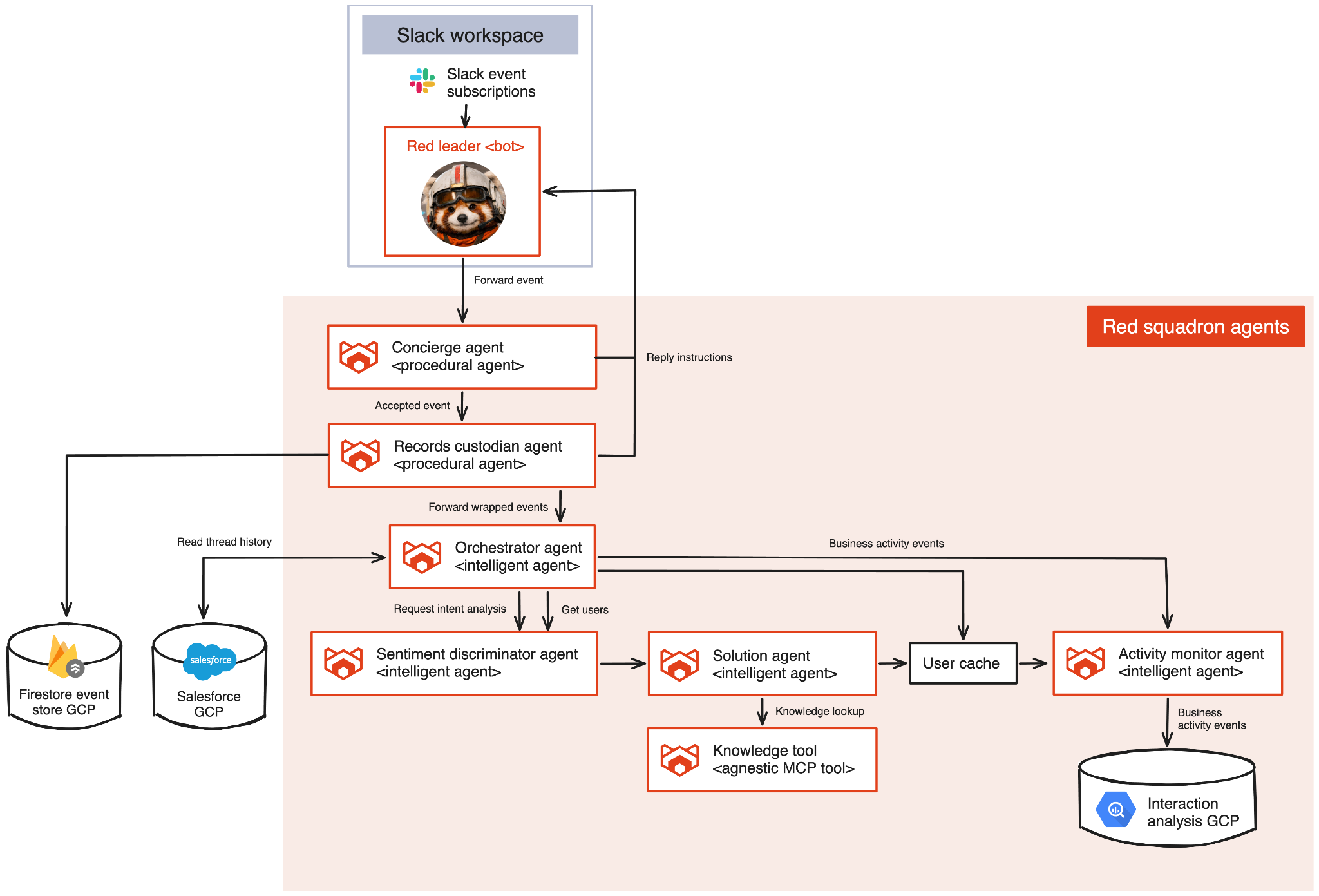
To produce agent “collaboration,” we needed a multi-agent AI habitat (often called a “Substrate”) in which agents can exchange structured events, enforce governance, and learn continuously. In this case, the Redpanda Agentic Data Plane is our substrate.
Redpanda Agentic Data Plane brings together:
We needed agents not just to act but to coordinate, specialize, and improve the experience together. This system now produces continuous event streams:
These are ordered, durable streams of intent, action, and reaction. Streaming serves as the agent-coordination mechanism and shared language of the ecosystem. Our business can track and trust the agents' operations, and the agents also communicate with each other through these events. We transformed from a capable agent into a coordinated system within a governed, autonomous ecosystem.
Sign up for Redpanda Cloud today and give Redpanda Streaming and Redpanda Connect a go. If you want early access to Redpanda Agentic Data Plane, get in touch.
In the meantime, you can dig into our Redpanda Connect workshop to learn the ropes and start building your own streaming pipelines.
Good intentions don’t work. Mechanisms do.
What two security operators learned from a decade of building at petabyte scale
What architects are asking about governance, data access, and control for enterprise agents
Subscribe to our VIP (very important panda) mailing list to pounce on the latest blogs, surprise announcements, and community events!
Opt out anytime.