


8 engineering lessons on running AI agents in production
What two security operators learned from a decade of building at petabyte scale


Highlights from the first day of Redpanda Streamfest 2025








It’s the first day of Streamfest, a virtual event where “streaming meets AI” that gathers the brightest minds in the industry to explore emerging technologies, discuss hot topics, and tour the trends shaping the defining decade ahead. With so many exciting topics to cover, this year’s Streamfest was split across two days:
From expert panels and customer use cases to product demos and a hands-on workshop, attendees were in for a memorable five hours. If you couldn’t attend the live event, you can watch all the Streamfest 2025 sessions on-demand. (Sign in once to unlock all the sessions, then click on an agenda item to watch it.)
If you’d rather just read what happened, here are the highlights from day one.
The Technical AMA opened a few minutes before the main event to entertain the early birds. Just like last year, it was manned by two ridiculously smart engineers who challenged attendees to stump them with a question. The prize? Swag.
And oh boy, did attendees want that swag.
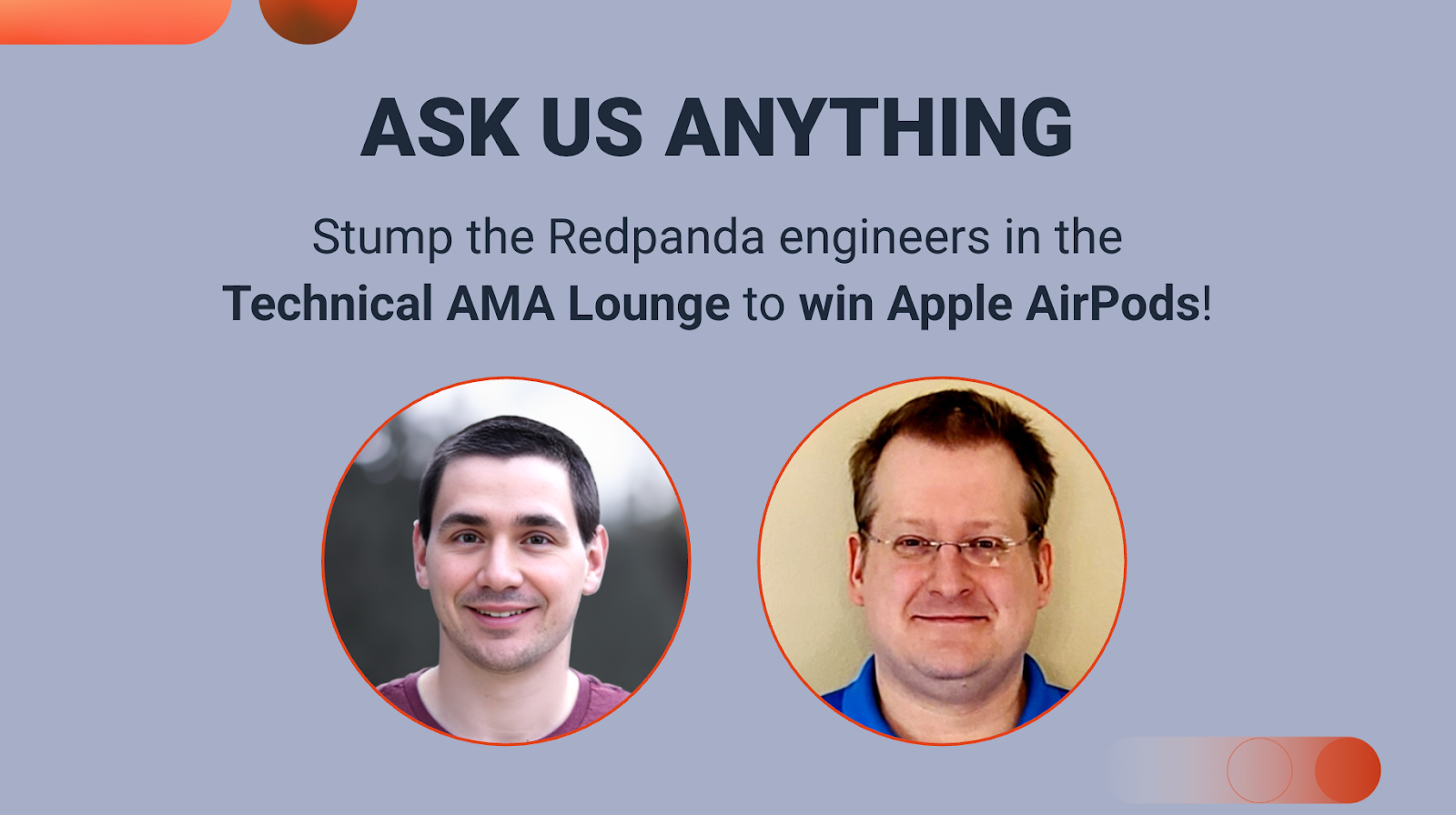
Questions filled the chat throughout the event, covering everything from Redpanda’s Databricks Unity Catalog integration to the recent Oxla acquisition. Our engineers aren’t easy to beat, but a few attendees did earn some swag for their valiant efforts.
Luckily, attendees would have more chances on Streamfest Day 2. Or as Wes put it, “I heard tomorrow you get a different team that’s better looking…”
Right on time, Redpanda Streamfest opened its virtual doors with Tristan Stevens (VP of Global Customer Success and our favorite MC) appearing across screens worldwide.
With a snazzy panda shirt and his usual British charm, Tristan gave attendees a warm welcome and explained how Streamfest was set up so everyone knew where to click.
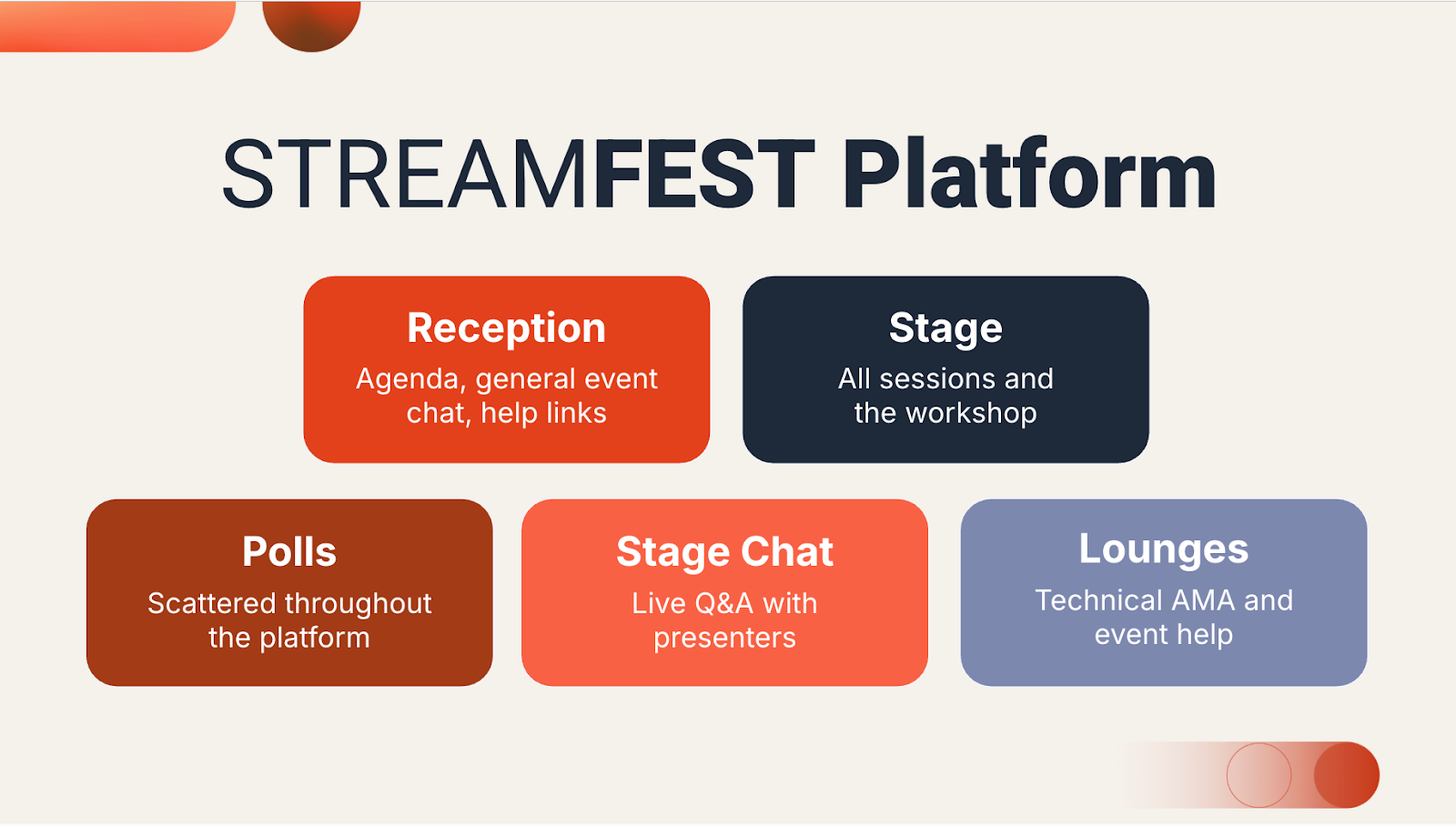
We’ll whizz through some of these below, focusing on the sessions so you can catch up on the good stuff.
Alexander Gallego, Founder and CEO, Redpanda
Who better to kick off the sessions than Alex. He began with an enthusiastic note on how grateful he was that over 2,000 attendees registered for Streamfest this year, and couldn’t be more excited to show everyone what was in store over the next two days.
Although with so many newly-minted pandas, it was only right to give them a proper introduction to Redpanda and what we’re working on.
In short, Redpanda’s blazing-fast data streaming platform powers mission-critical use cases across global companies, from cybersecurity providers and pioneering AI companies to the world’s largest stock exchange.
Now with the age of AI upon us, Redpanda has been evolving its products to help developers build for that future, too. If you haven’t already, meet our latest innovation: the Agentic Data Plane.
“This new era requires a new kind of data platform — one that’s not just real-time, but simple, efficient, and safe enough to power the next generation of AI and agentic applications.”
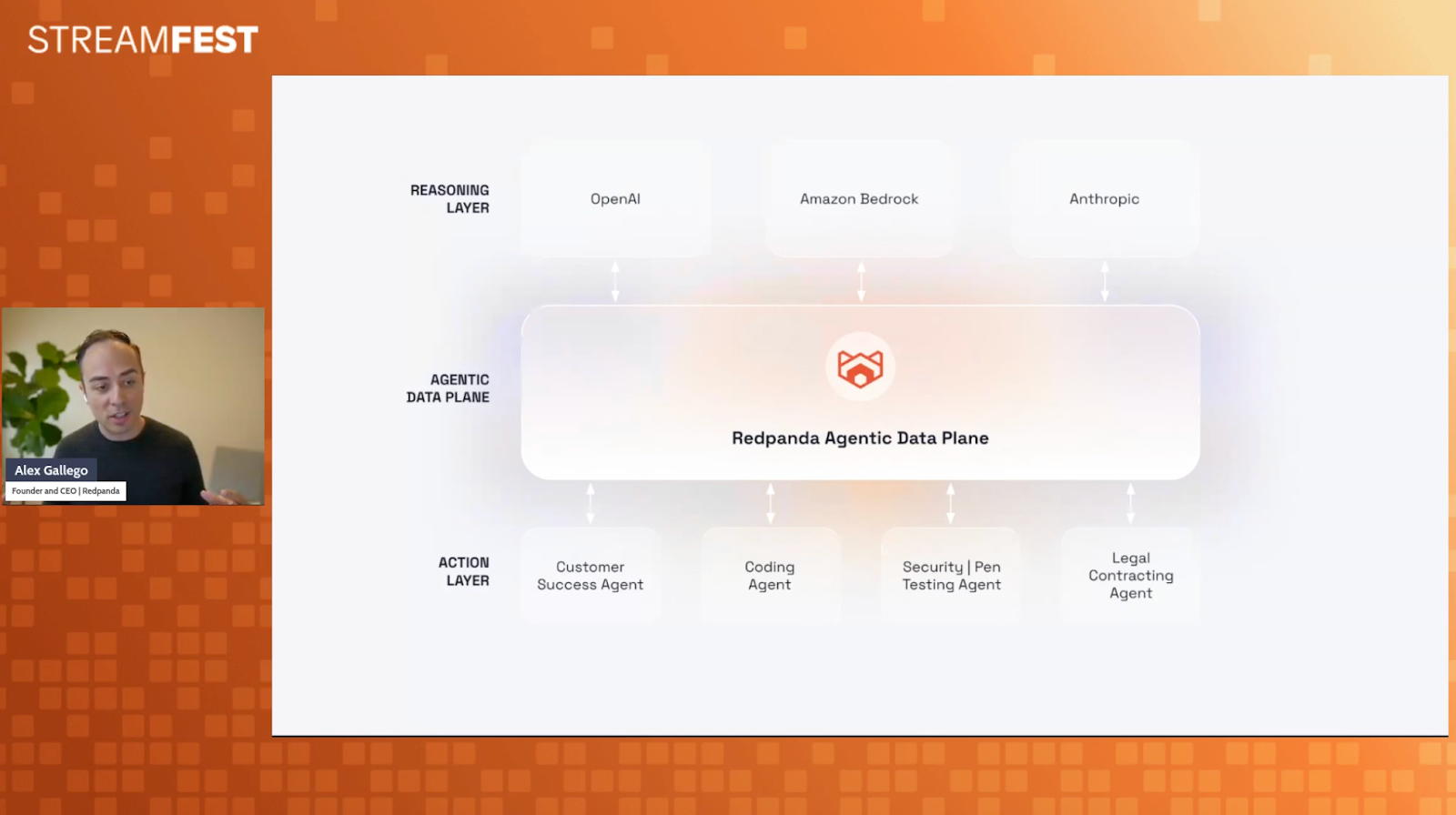
Alex concluded his session on a high note: we’re shipping a powerful set of features designed to help you build, operate, and govern these new applications safely, even at enterprise scale. And with that, he handed the screen over to to our CTO, Tyler Akidau, to fill everyone in on how and when these features will be ready.
Tyler Akidau, CTO, Redpanda
At Redpanda, we’re always excited about what’s ahead, but we’re equally as excited to bring you along for the ride. In his session, Tyler presented the Redpanda roadmap along with a deeper dive on the Agentic Data Plane.
For context, AI agents are quickly evolving from simple copilots into autonomous digital workers. But the data pipelines, governance policies, access controls under the hood aren’t maturing as quickly, particularly for the enterprise. The Agentic Data Plane changes that story. It’s a managed, governed data control plane that connects agents with enterprise data safely and seamlessly.
In true Tyler fashion, he framed his session with a Dungeons & Dragons alignment grid, where each grid represents a personality type. Instead of D&D characters, this one describes AI agents.
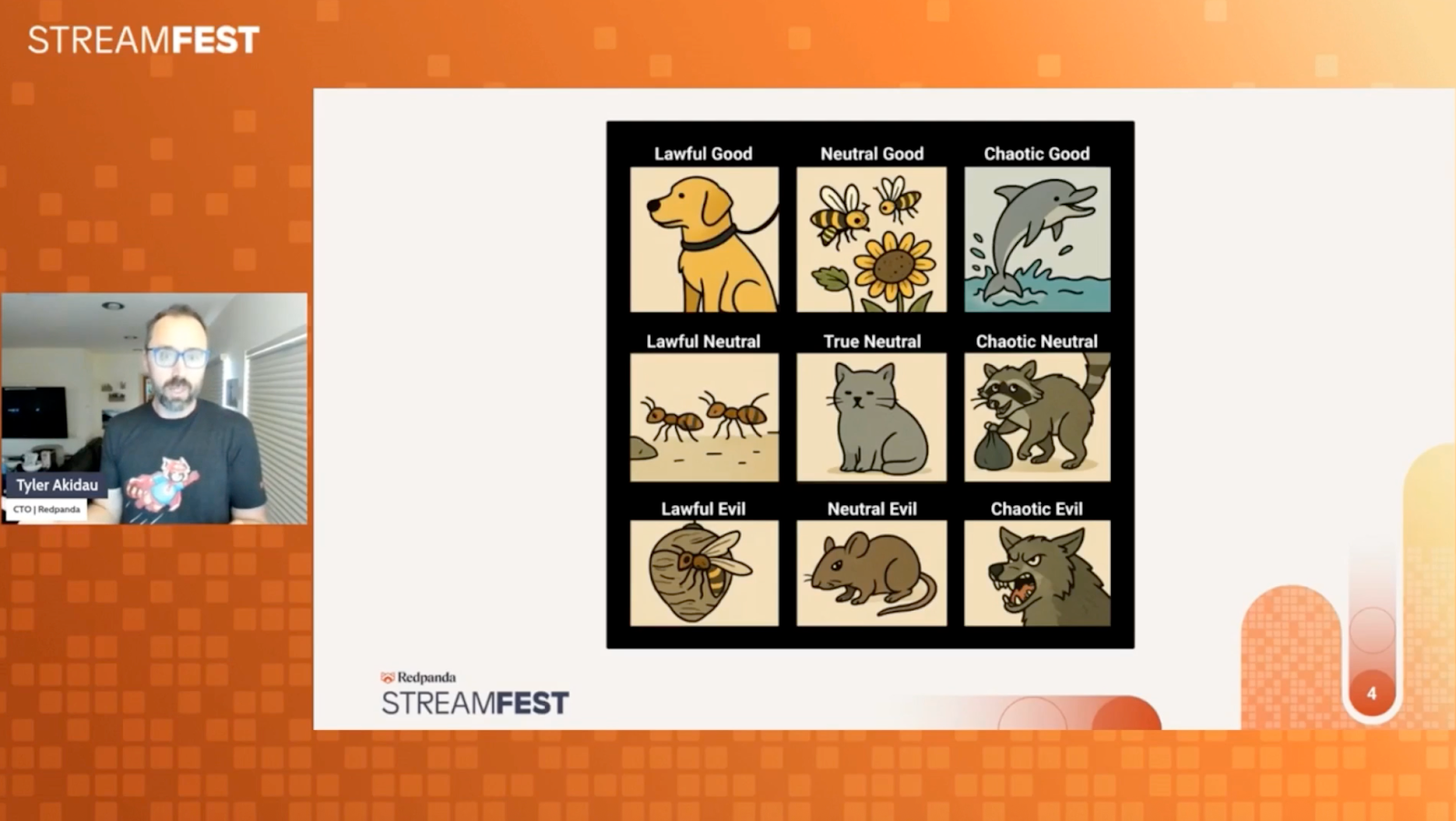
The crux is you have AI agents with superhuman productivity, but from a personality perspective, they're still chaotic. If they were human, you’d never hire them, let alone give them direct access to company data.
So, how do we bring these highly capable (yet chaotic) agents into the enterprise? Tyler explained that Redpanda is currently expanding our already solid foundations (streaming platform, connector suite, and BYOC model) to deliver on the three pillars for effective enterprise AI adoption: data, governance, and AI.
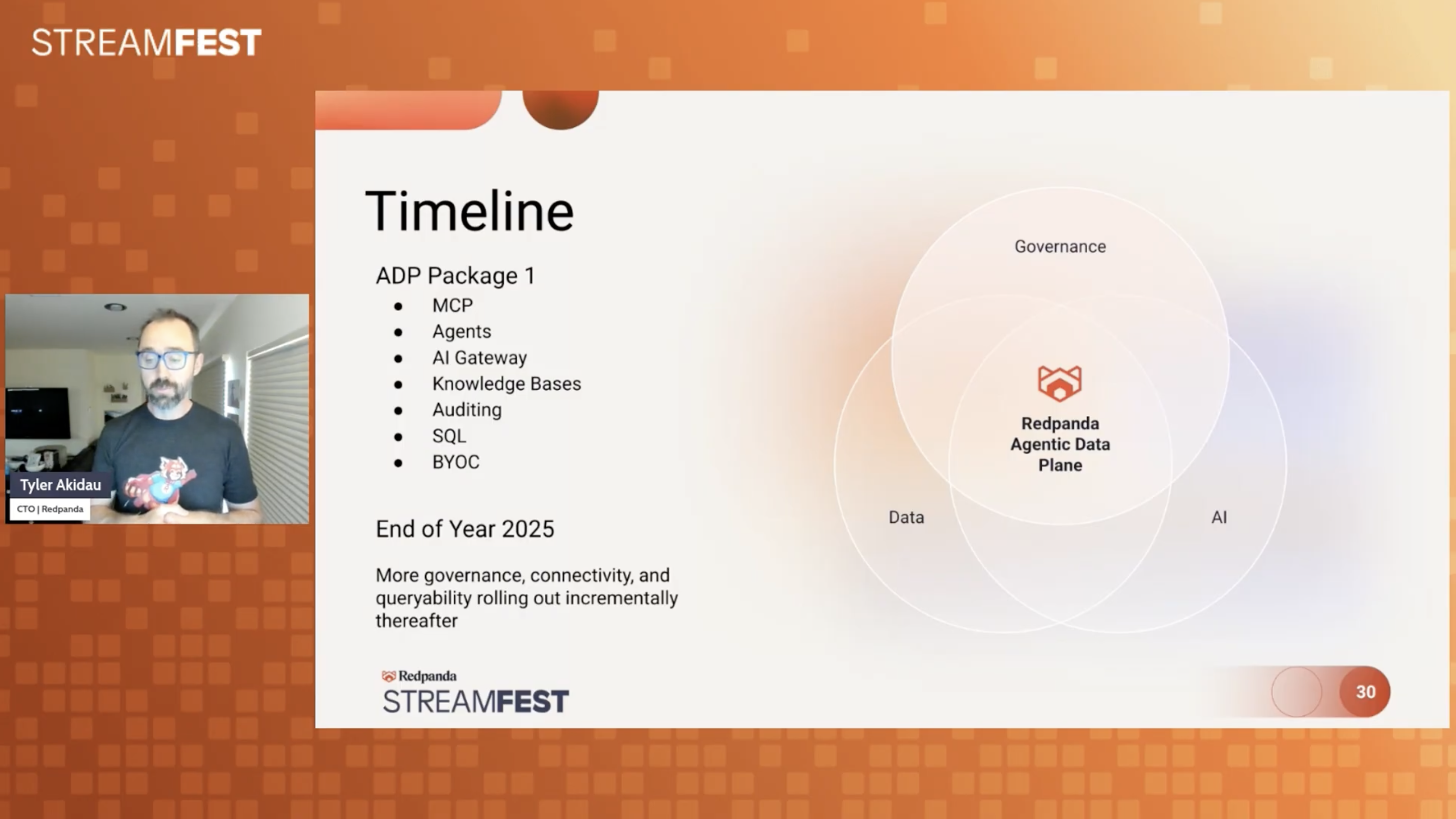
The first rollout of Agentic Data Plane tools is expected by the end of 2025, with even more planned for 2026. Excited? We sure are.
To learn more about how Agentic Data Plane works under the hood, check out Tyler’s blog on the path to enterprise Agentic AI.
Johannes Brüderl, Principal Software Engineer, Redpanda
Redpanda Streaming and Redpanda Connect are already known and loved for connecting agents to data and systems with durable, real-time messaging. Now with Oxla, we can add real-time querying to the mix.
As Oxla is the latest member of the panda family, Johannes from the Redpanda Cloud team demoed how Oxla integrates with the Agentic Data Plane. Here’s the TL;DR of what he used:
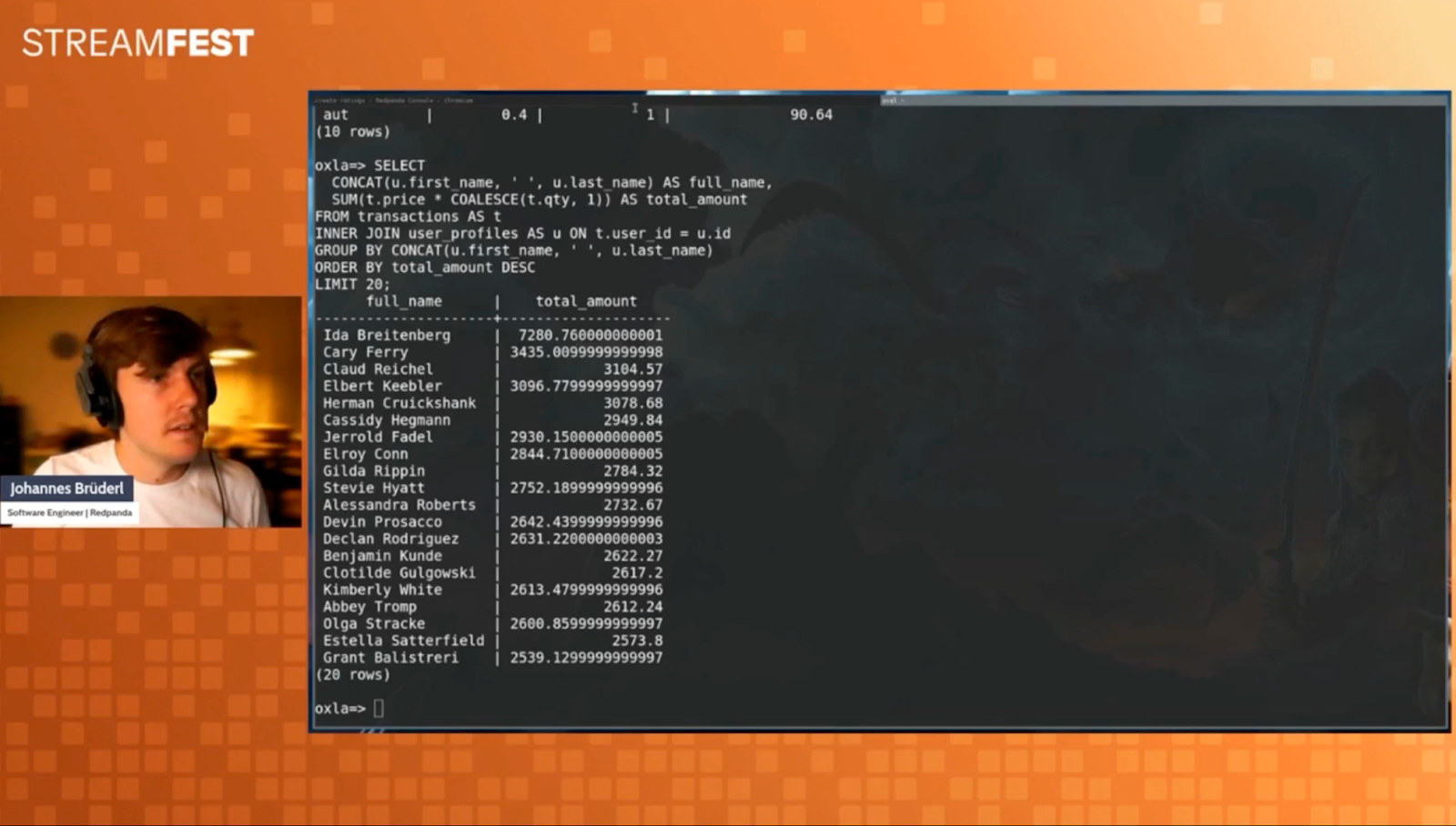
To dig deeper, check out Johannes’ blog on building low-code MCP servers in Redpanda Cloud.
Garrett Raska, Solutions Engineer, Redpanda
To keep the Remote MCP momentum going, Garrett’s session whizzed through building Remote MCP servers for AI agents.
In a nutshell, Garrett demonstrated how to build a knowledge base and provide it as a Remote MCP server to an AI agent. The financial sentiment agent (who we shall name Gary) had multiple tools at it's disposal to produce in-depth analysis. To make sure Gary was behaving properly, Garrett walked through testing and triggering Gary in a pipeline. (Spoiler: it did well.)
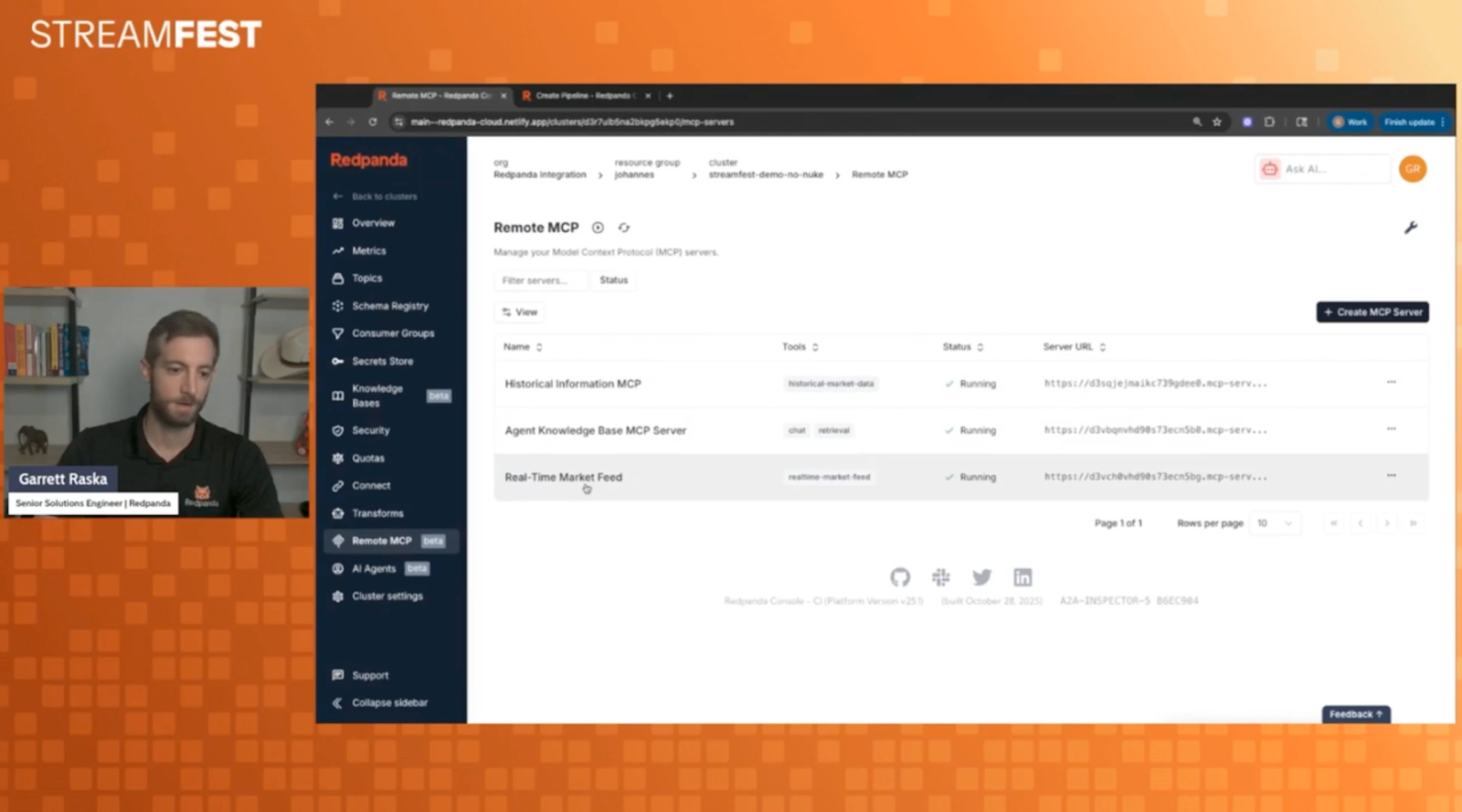
It's as fascinating as it sounds, so definitely go watch the full demo.
Tyler Rockwood, Principal Software Engineer, Redpanda
It’s always nice to see a company actually using its own technology in production. To showcase how we’re using AI agents internally, the ever-friendly Tyler Rockwood introduced everyone to Redleader, an AI agent that mainly works within our Slack.
Its mission? To track down information across our resources and bring the right answers to common questions at the right time (so our humans can focus on answering the toughest ones).
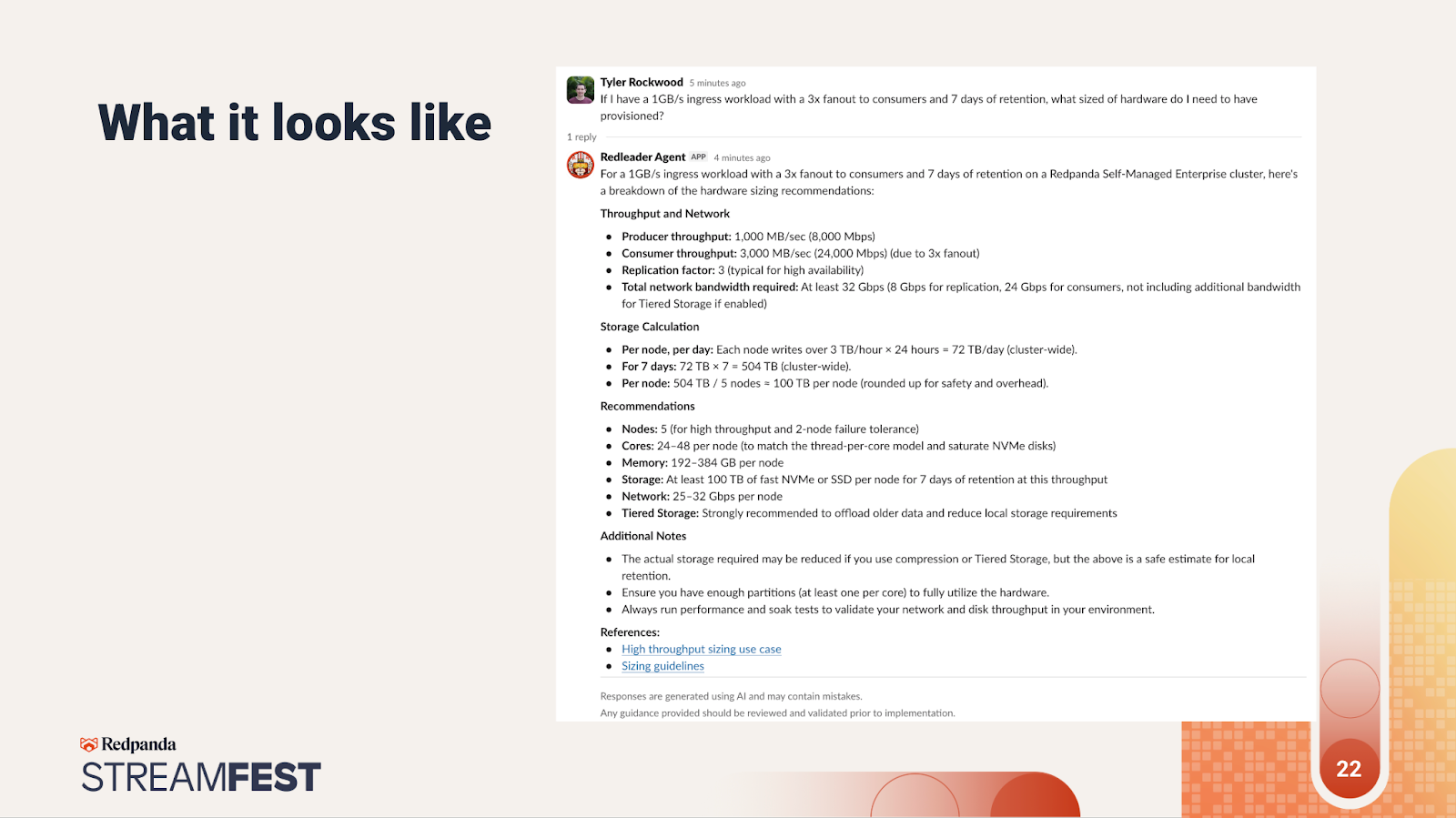
For a bit more backstory, our support team is famous for being fast, thorough, and so efficient that problems are often solved before the customer even realizes there were any. For customer questions, we use Slack so their technical folks can chat directly with our technical folks. Most of the time, the answers are in our documentation or even a blog post, but people tend to prefer asking someone and getting a direct answer.
Enter Redleader to the rescue.
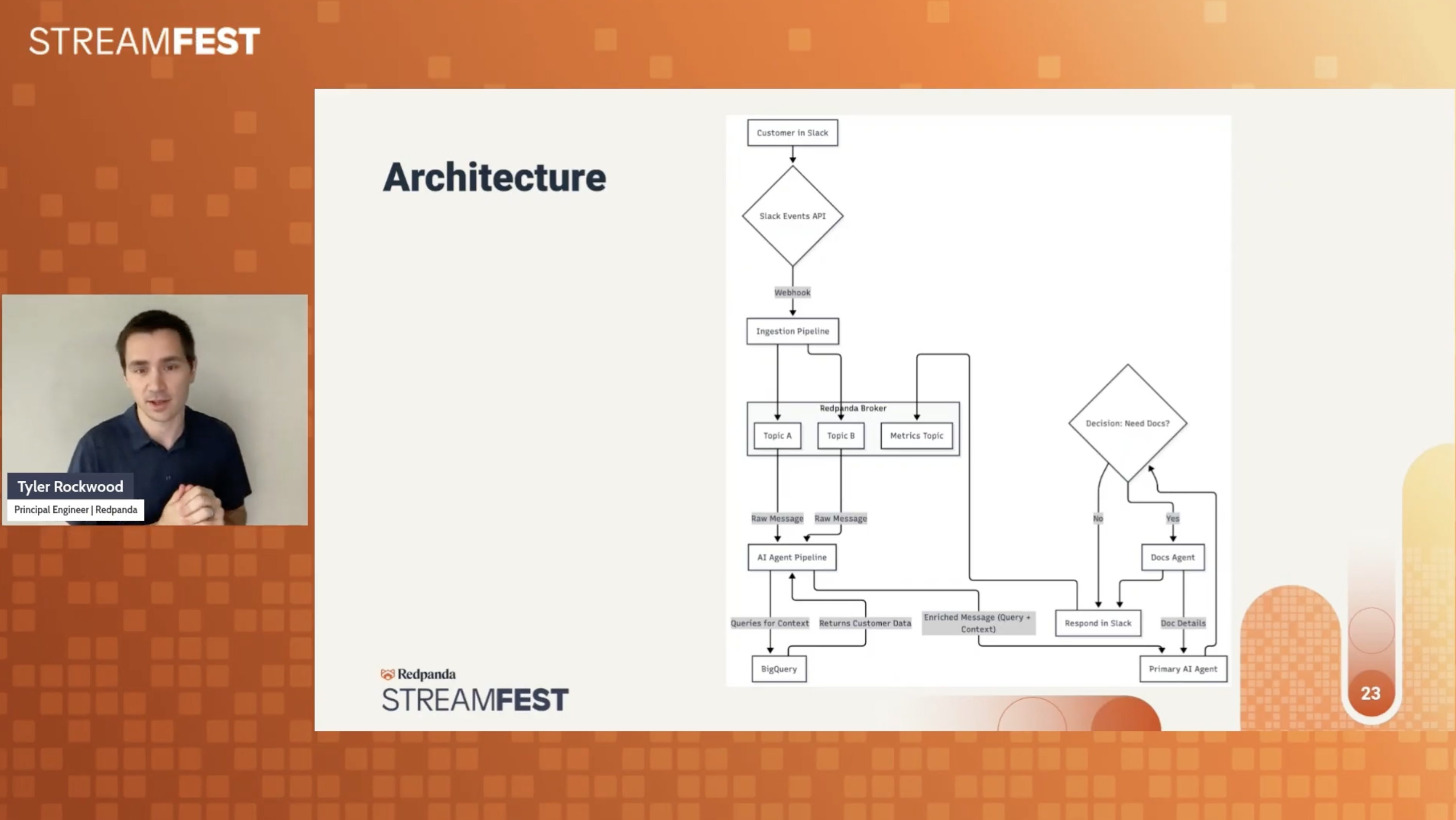
In his short but sweet session, Tyler showed example of how this AI agent works under the hood and how it’s working out so far.
Ash Edwards, Head of Forward Deployed Research Engineering, Poolside
Poolside is a frontier model research company that builds foundation models, agents, and orchestration systems to transform how work gets done in the enterprise.
As a kindred spirit, poolside is our ideal partner for enterprise agentic AI, where Redpanda makes 300+ enterprise data sources instantly and securely available to poolside’s agents across every environment.
In this session, Ash kindly explained what poolside is all about and the exciting updates they’re currently working on.
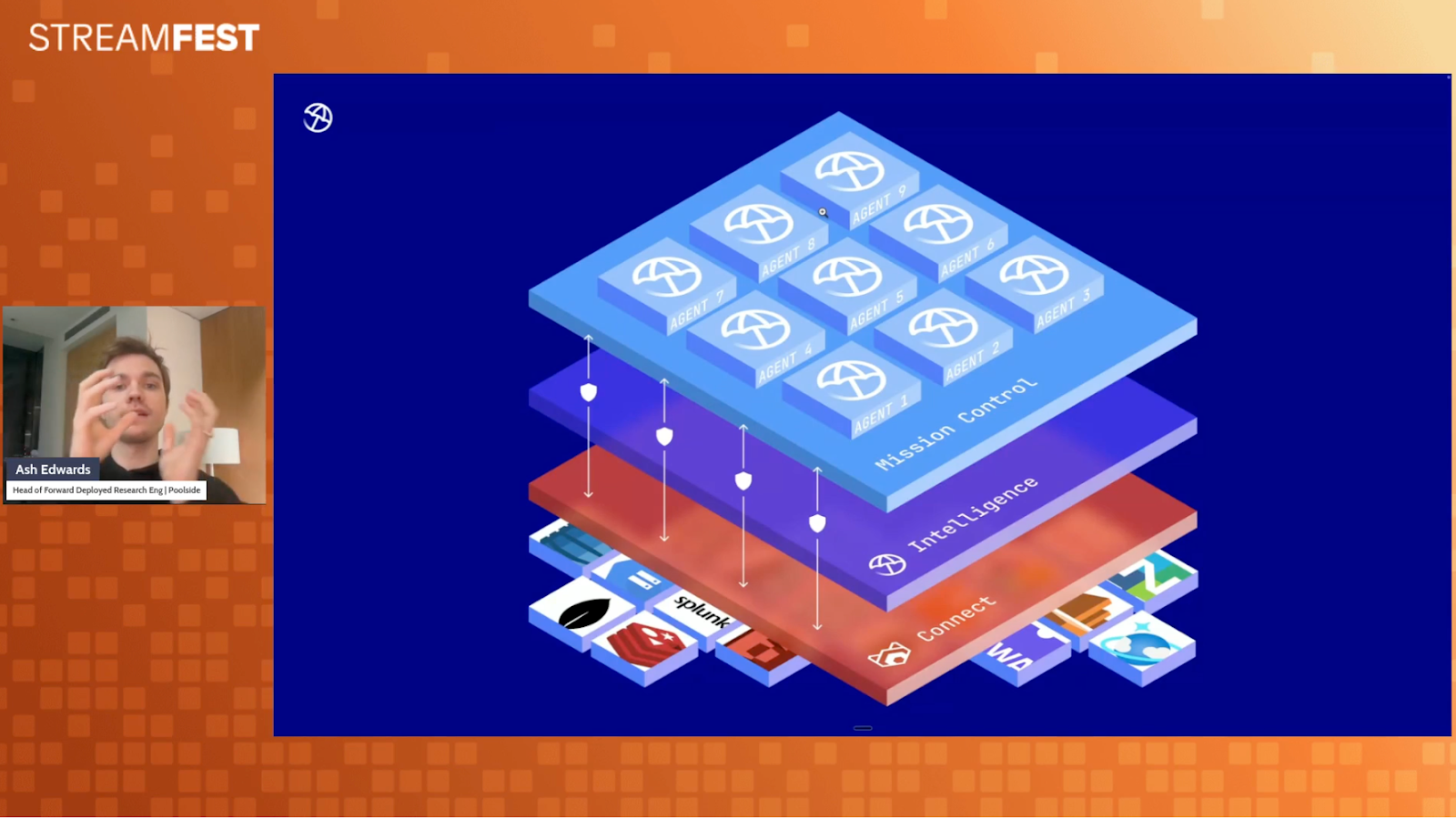
Watch Ash’s presentation to learn how both companies are working towards a future where enterprises can effectively deploy agents at scale.
Peter Kraft, Co-founder, DBOS, Inc.
There are many reasons for a system failure (shout out to Murphy’s Law). The fact is, building reliable systems at scale is hard, and any part of your system can break at any time for any reason.
Well, good news! AI applications are even worse.
Now you get to worry about unpredictable code paths, rate-limited AI APIs with frequent outages, and large-scale parallel data processing that’s essentially a recipe for disaster. AI applications need to be reliable, and Peter helpfully gives a few pointers on how to make this happen (in the real world).
Meet durable workflows. The idea is you write the workflow and regularly save the state of an app to a database so you have a recovery point in case of failure. Think of it as save points in a video game. Most durable programs are written as workflows of steps, where each step takes in an input, does some work, and returns an output. The workflow then wires all the steps together.
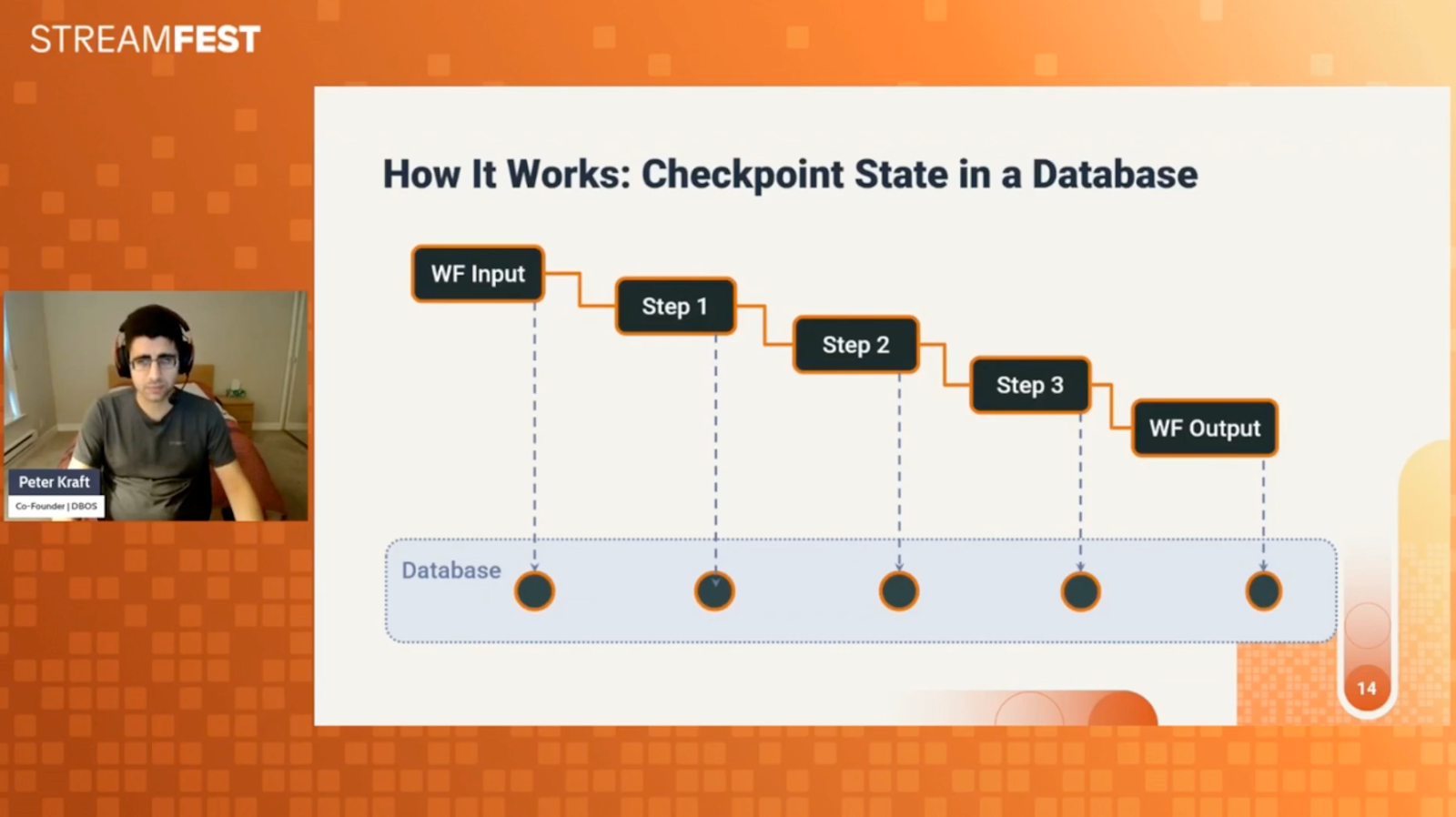
Where does Redpanda come in? You can invoke an AI agent built on DBOS durable workflows, directly from within Redpanda Connect pipelines. For more details, watch Peter’s Streamfest session.
Oded Nahum, Global Head - Cloud & Data Streaming Practice, Ness Digital Engineering
Our Head of Partnerships, Romano Ninassi, introduced the wise Oded for an insightful chat on how architectures are evolving from event-driven to AI-driven — and what that means for humans.
Oded would know, considering he leads the effort at Ness Digital Engineering, a global provider of intelligent data and software engineering services that help enterprises modernize its systems and accelerate product development.

“We’re moving from a rigid, hard-coded, deterministic intelligence to something adaptive — that can reason and evolve.”
This shift comes with complexities and challenges, namely governance. Oded says the biggest challenge with governance is, “giving agents enough autonomy to be useful, but not letting them go crazy.” It’ll be a continuous exercise of tuning and training, which definitely needs a human in the loop. Someday we’ll get to fully autonomous agents, but right now, Oded says we’re still in the “Wild West” of agentic AI.
Oded’s closing thought was there’s a lot of hype around AI agents, but there’s also a clear direction, and with Redpanda’s partnership he trusts Ness will do great things for enterprise customers looking to deploy AI agents safely and responsibly.
On that note, if you want to become a Redpanda Partner, check out Redpanda.com/partners
Governance was certainly the leading topic of the day. To bring it all home, this session channeled expert knowledge and experiences from a distinguished panel that knows governance better than most.
To spark the conversation, Alex started with agentic AI in the all-important cybersecurity industry — a perfect question for Shil Sircar, VP Product Engineering and Data Science at Arctic Wolf, a leader in security operations.
Shil shared that the company processes a trillion events per day, then trains its models on this data to teach them how human analysts would respond to certain events. Reassuringly, Shir stands firm on what the goal for AI agents should be.
“AI agents shouldn’t replace human analysts but extend their reach.”
Alex’s next question was about data access and governance, which are particularly important for Kannan D.R, Chief Architect & VP of Engineering at LiveRamp (a data collaboration platform). With around 96 Petabytes of data, their main challenge is how to safely share such magnitude of data with AI, as well as building precise guardrails to share it safely (well hello, Agentic Data Plane).
Arya Ketan, a Distinguished Engineer at ShareChat, India’s largest social network, chimed in from his experience handling the chaos that's social media.
“No matter how systems evolve, software principles don’t change. We will always need access controls and authorization, and they’ll only be more critical for AI agents.”
To wrap up the session, Alex asked about ensuring AI agents remain auditable, which as Shir points out, just circles back to governance.
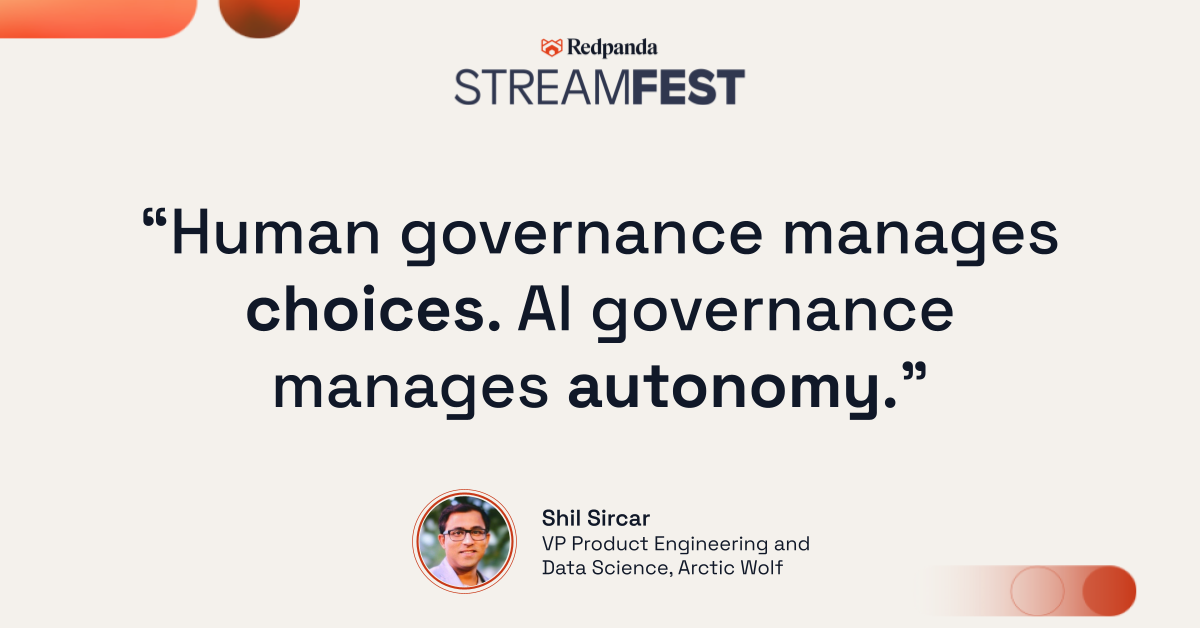
Shir says the industry is struggling with agentic governance because it’s focusing more on restricting autonomy, rather than shaping it. In truth, it’s about calibrating intelligence to create a perfectly explainable governing system.
This is only a drop of knowledge from this panel, so if you can only watch one session about governance today, make sure it’s this one.
Chandler Mayo, Developer Advocacy Lead, Redpanda
After learning about all the cool things Redpanda offers for AI agents, it’s only natural that developers would want to try it themselves. So, the last session of the day was a hands-on workshop entirely designed for beginners.
Chandler’s session zoomed in on how Redpanda helps with logging and observability, so you can reliably handle streams of events and easily scale when needed. To show it in action, he walked through setting up a lean AI agent that emits real-time data, and then using Redpanda Connect to filter that data for different uses.
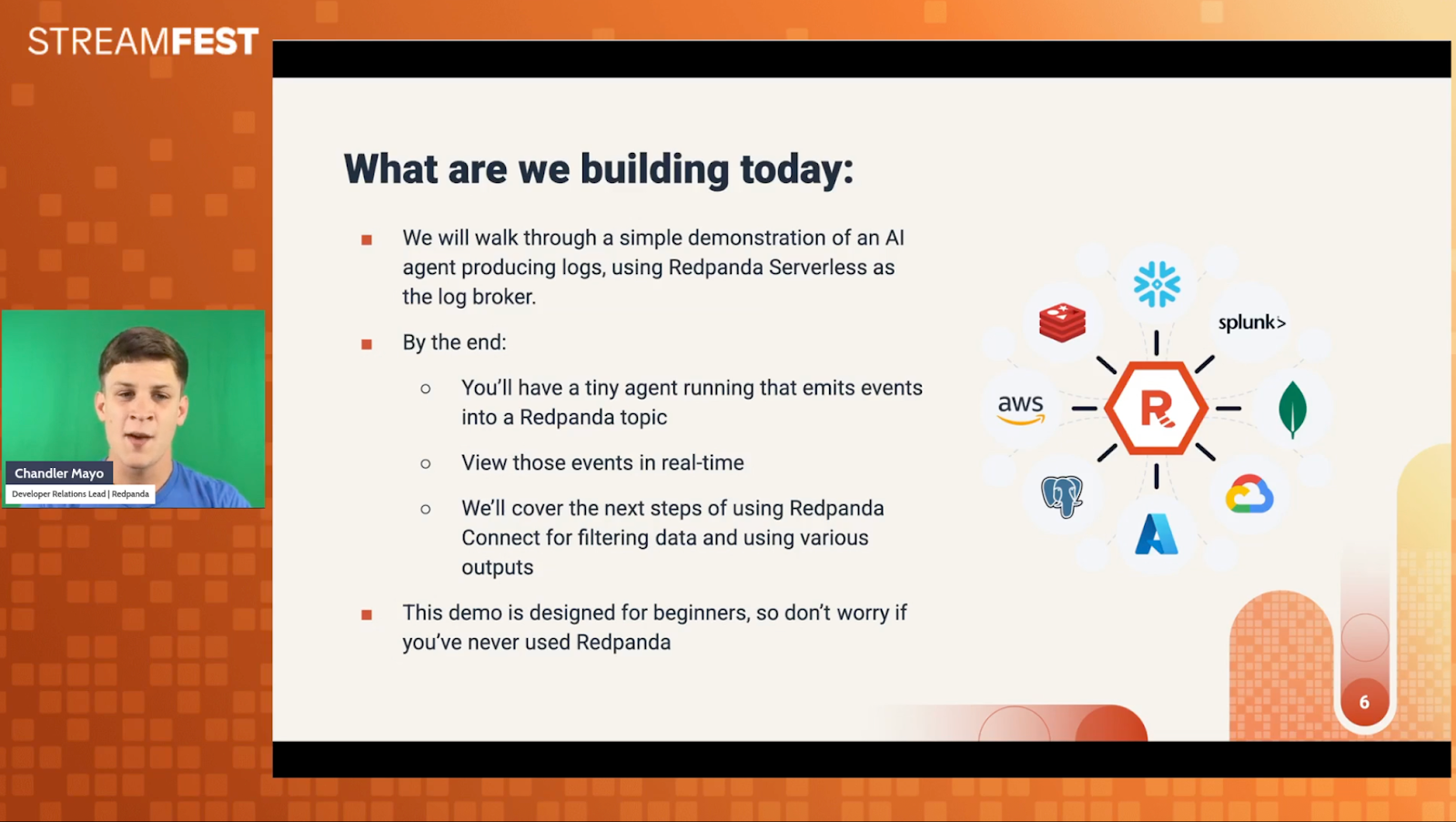
No Redpanda experience needed. Just you, your laptop, and the workshop. Go ahead and watch this and all Streamfest sessions on demand. Sign up once, access them all.
After five action-packed hours, Tristan briefly reappeared for a closing note before heading off to make himself a cup of tea (because of course). And with that, the curtains closed and the first day of Redpanda Streamfest came to an end.
But not to worry, there’s another day of keynotes, panels, and cool engineering demos ahead — this time focused on data streaming. So head over to see what happened on Streamfest Day 2!
What two security operators learned from a decade of building at petabyte scale

Redpanda Shadowing now carries topic data, schemas, offsets, and ACLs on a single link for a low-risk, no-data-loss cutover
What architects are asking about governance, data access, and control for enterprise agents
Subscribe to our VIP (very important panda) mailing list to pounce on the latest blogs, surprise announcements, and community events!
Opt out anytime.