Push-button migration from Confluent to Redpanda
Redpanda Shadowing now carries topic data, schemas, offsets, and ACLs on a single link for a low-risk, no-data-loss cutover


One engine. Every workload. No more streaming sprawl








If you’ve been following the Redpanda journey, you know we aren’t big fans of the status quo. For too long, the streaming industry has forced engineers to live in a world of compromises. You either balanced a perpetual speed-performance tradeoff, or you managed a zoo of niche services to save on your cloud bill.
Today, we’re ending the trade-off. Redpanda Streaming 26.1 is officially here, delivering our Redpanda One (R1) vision and making Cloud Topics generally available. We’ve transformed Redpanda into the industry’s first adaptable streaming engine: a single, multi-modal platform that lets you toggle between single-digit-millisecond performance and massive-scale efficiency at the topic level.
One engine. Every workload. No more sprawl.
The headline of 26.1 is "General Availability of Cloud Topics," but the real story is the end of the streaming zoo. Most vendors solve the problem of high-volume, latency-tolerant data by telling you to spin up a specialized diskless cluster. That sounds fine until you’re managing three different technologies, three different security models, and three different ways to do observability.
Cloud Topics is the object-storage-friendly cure for this operational sprawl. Instead of spawning a new cluster for your telemetry firehose, you simply toggle a topic to write directly to S3 or GCS. You get the 90% cost savings of a diskless system without the trade-offs. No learning a new engine, no managing a second (or third!) stack, no separate availability guarantees, and no debugging separate engine behaviors at 3 AM. It’s one engine, one API, and zero unnecessary clusters. R1, ftw!
Let’s be real: scaling streaming data in the cloud is expensive. The biggest culprit isn't usually the software; it’s the cross-AZ data transfer fees. Traditional Kafka replication moves every byte of data between Availability Zones (AZs) multiple times, leading to networking bills that look like telephone numbers.
The industry’s answer has been diskless architectures. But diskless isn't riskless. By moving everything off of local disks in favor of object storage and external databases, these systems sacrifice data integrity, availability, and core Kafka features (like transactions) on the altar of cost.
Cloud Topics use a pass-through write model that saves the bulk of your messages directly to object storage. We stream the heavy message payloads directly to S3 or GCS, but we keep the brains of the operation—the metadata and Raft consensus—on high-performance local NVMe.
You get over 90% lower networking costs and the economics of a diskless system, while keeping the battle-hardened reliability of a local-disk broker that can safely run low-latency workloads alongside these topics. No broken transactions. No metadata lag. No external control plane dependencies. Just efficient, Raft-consistent streaming.
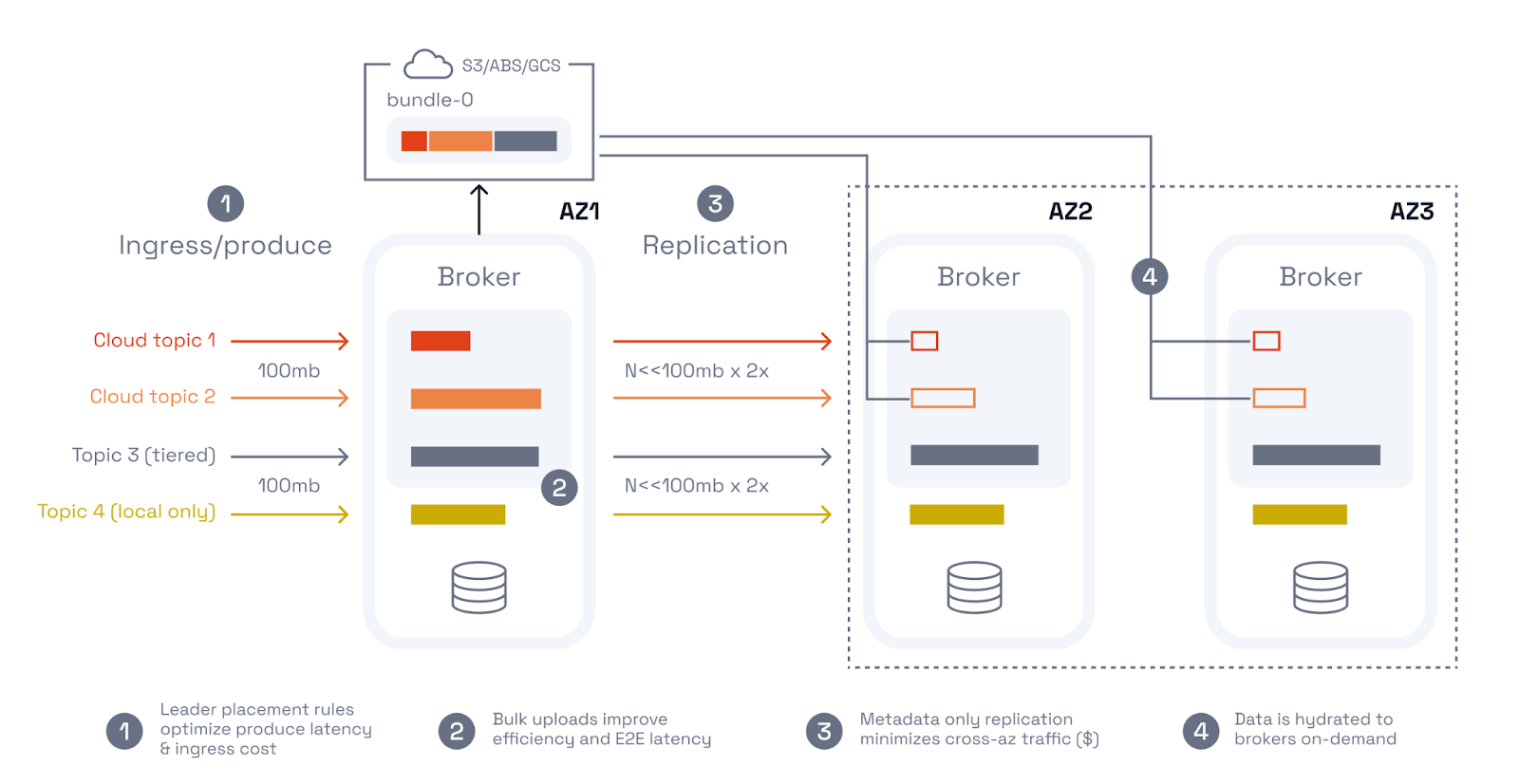
Want more on the architecture? Check out our technical deep-dive on the architecture of Cloud Topics.
If you’ve ever had to manage individual ACLs for more than a dozen different users across multiple clusters, you’ve probably considered a career in goat farming. It doesn't scale, it’s error-prone, and it’s a security nightmare.
With 26.1, we’re introducing Group-Based Access Control (GBAC). Instead of micromanaging permissions for every single "Bob" and "Alice" in your organization in each cluster, you can now map roles or permissions to groups provided centrally by an Identity Provider (IdP). Access control that automatically absorbs your organization’s changes delivers a "set it and forget it" model for authorization that finally brings sanity to enterprise-scale streaming security.
Whether you’re dealing with internal teams or complex multi-team environments, GBAC ensures your security posture evolves with your infrastructure, not against it.
Tired of micromanaging Bob from accounting? Learn how to simplify your security posture in our GBAC documentation.
Scaling across regions used to mean choosing between "slow" or "expensive." Redpanda 26.1 introduces ranked rack preferences for Leader Pinning, allowing you to deterministically list which regions and AZs should host your partition leaders. It turns leader placement from a game of chance into a strategic advantage. You can actively shape traffic by pinning leaders to the specific locations where your producers live, eliminating much of all of the ingress costs for these topics.
To complement this write-path optimization, Cross-Region Remote Read Replicas for AWS allow you to decouple your global read traffic from your production cluster. By accessing topics through S3 instead of the network, you can serve reads in AWS regions worldwide without putting any workload on the production cluster, at a much lower cost than using a "stretch" cluster. It’s the easiest way to scale reads globally without the operational overhead stretch or multi-cluster replication.
Your data travels for business, not pleasure. Stop letting it run up expenses on the scenic route and fly direct with Leader Pinning and Remote Read Replicas.
We couldn’t fit everything into one post without it becoming a novella, but 26.1 is packed with updates that make life easier for the on-call engineer:
For the full list of nitty-gritty details, head over to our release notes.
Redpanda Streaming 26.1 is the culmination of a vision in which engineers don't have to choose between speed, safety, and cost. It’s the Redpanda One engine, and it’s ready for your most demanding workloads.
Try Redpanda 26.1 today with an Enterprise Edition trial license and a freshly pulled container. Plus, join us for the launch streamcast on April 2 to see it in action.
Redpanda Shadowing now carries topic data, schemas, offsets, and ACLs on a single link for a low-risk, no-data-loss cutover

A database designed for agentic governance, now available on Google Cloud
Subscribe to our VIP (very important panda) mailing list to pounce on the latest blogs, surprise announcements, and community events!
Opt out anytime.