An agent kill switch is a database problem
Stopping a misbehaving agent means joining identities, tools, prompts and policies in real time as events stream in. That workload shaped how Redpanda built its SQL engine.


Agents are less predictable than traditional software and more technically capable: proficient across many domains, often with root access to your systems, and able to write code for novel tasks. For a CISO, that is a hard combination to rein in.
The good news is that you can design out-of-band rules and enforcement for agents, so your systems aren't in the press with a zero-day exploit next week. If you accept that out-of-band systems are the only reliable way to enforce boundaries on agents, the next question is what those systems need underneath them. The answer turns out to be a database.
A kill switch is a real-time join
An agentic kill switch watches signals as they arrive and acts on them. That means correlating identities, tools, prompts, models, transcripts, historical behavior and policies in real time while ingesting a continuous stream of events. Agent governance workloads are fundamentally join-heavy.
Agents don't behave like traditional applications. In a loop, they are constantly making decisions, accessing systems and taking action. Managing agents at enterprise scale requires real-time visibility into their behavior, context and impact, historical trends, and a full graph of agent-to-agent calls where you may not have written either the upstream or the downstream agent. Those assumptions demand a new kind of data infrastructure, with a policy engine that governs agents through channels they can't see or touch.
The goal is real-time anomaly analysis that can trip a circuit breaker on a misbehaving agent: the agentic kill switch, first previewed with the launch of the Redpanda Agentic Data Plane.
Built for joins that scale with every core
Redpanda SQL (formerly Oxla) targets a specific design point in database research: SQL joins that scale linearly with the number of cores, and a ring-buffer-based shuffle algorithm that keeps every core saturated. In analytical systems the bottleneck is memory-to-core bandwidth; vectorized execution, compressed data types and specialized hash tables all exist to make each trip to memory count.

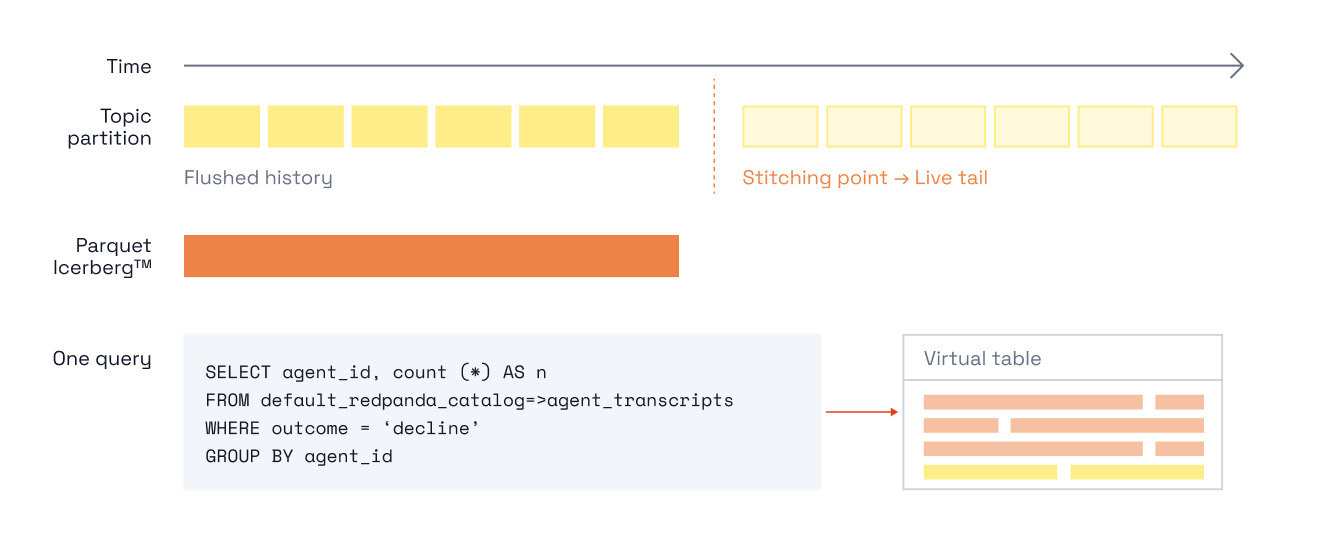
To work on signals arriving in real time, the engine leans on the stream-table duality Redpanda calls bridge queries. The analytical layer can ignore where data is stored, how it's stored and how fast agent transcripts arrive, with their tools, agent instance IDs, prompts, models, failures, retries and conversations, and still detect trends and stop agents when they misbehave.
Postgres compatibility is the other half
Many SaaS products are a disaggregated database. Salesforce acts and feels like one. Redpanda Streaming is one too: an immutable log, which sits at the heart of nearly every persistent system (and yes, you do need to flush to disk). The question was what an agentic kill switch needs, from first principles, to handle the difference between humans who click and agents that swarm.
Two requirements came out of it: high-performance joins at scale, and compatibility with Postgres, which has become the common language of databases. Choose almost any tool and it already speaks the Postgres protocol.

Open protocols, no lock-in
The architecture in most customer deployments has three layers. A connectivity layer moves data in and out of systems. A catalog organizes that data with schemas, access controls and indexes for later analytics. A processing layer underneath consumes the catalog and data both in motion and at rest.

Open protocols are what tie those layers together. Representing streams as tables, with schema evolution and governance (access controls, authentication, authorization, RBAC, OIDC) behind a single entry point that agents or people can query, is the kind of freedom CIOs ask for. It can be deployed in your own cloud (BYOC or BYOVPC).
Why data residency decides where it runs
For data-intensive workloads, data residency is the dominant cost. Shipping data across clouds wasn't viable for Google Cloud customers, so Redpanda SQL is now generally available on Google Cloud as well as AWS.
It ships as a Bring Your Own Cloud deployment, so no data leaves your firewall. With BYOVPC on AWS and GCP, customers keep full control over networking and security, deploying in a new or existing VPC, with the benefits of a fully managed service.
Why an agent governance company built a query engine
Governance at scale, with a kill switch, guardrails, evaluations and an AI gateway routing tools and models, isn't possible without joins at scale, the ability to absorb swarms of agents logging data, and compatibility with existing protocols and tools like Iceberg and Postgres. That is why the database sits underneath the Agentic Data Plane and the agents it governs. The technical details are in the Redpanda SQL docs.
A kill switch is only as fast as the system that decides when to pull it. Because that decision means joining identities, tools, prompts and policies on live data, agent governance is a database problem first.
Signals shortlist
Ground Truth is written and edited by Redpanda and invited contributors. Research methodology and sources are listed in each story.