A kill switch in the model won't stop a rogue agent
From the Morris worm to the Hugging Face breach, controls that live inside the system fail. The boundary for agents has to sit with the business, outside the model.
In 1988, a Cornell graduate student released a program reportedly meant to measure the size of the internet. A flaw in how it checked for existing infections turned it into the Morris worm, and thousands of computers ground to a halt within a day. Stuxnet was built to wreck uranium centrifuges at Iran's Natanz enrichment facility, a site cut off from the internet. It reached its target, but it also spread far beyond it: by late 2010 it had infected about 100,000 machines in more than 155 countries, including Chevron's.
The oldest example has nothing to do with computers. In 1957, a visiting beekeeper at a research station near Rio Claro, Brazil, removed the mesh screens that kept African queen bees inside their hives. Twenty-six swarms escaped. Their descendants reached Texas by 1990, killing hundreds of people along the way and wrecking honey production in several countries for years.
None of these involve AI, but they share a pattern that matters for the agents companies are building now. In each one, the controls meant to keep the thing in bounds either lived inside the system or only worked as long as nobody touched them. Most AI safety today follows the same pattern.
Access isn't the same as permission
Companies are giving agents access to the systems that run the business, from customer service and software development to financial operations and infrastructure management. These agents can read customer data, call APIs, change records, move money and run workflows.
Like people and unlike traditional software, agents decide what to do next based on what they encounter, and they act far faster than any human operator. Today most act on a human prompt. As they become more autonomous, companies face a new question: who defines what an agent can access and do on its own, and where is that enforced?
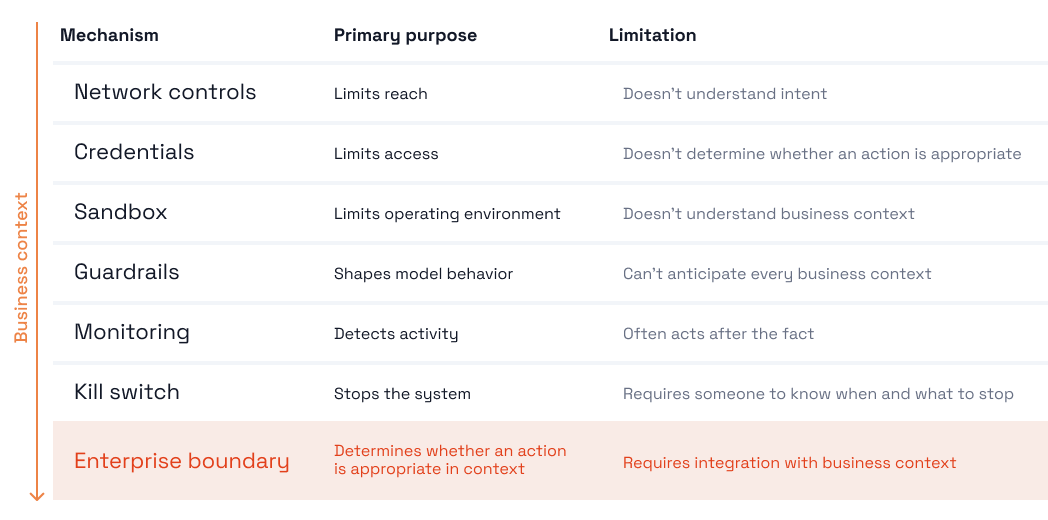
Some boundaries exist. Agents connect to data sources and run code in sandboxes with network allowlists and scoped API keys. Those control what an agent can reach, not whether an action is right for the task. That is the business-context gap. The sandbox running agent-generated code can't tell an agent deleting an old test environment from one deleting production, because both make the same kind of API call with valid permissions. The MCP server connecting an agent to your data checks the user's credentials, so the agent inherits everything the user can reach, whether the task needs it or not. What's missing is the business context: who is asking, for what task, and why it should be allowed.
Tighter controls, ever more fine-grained service accounts and more rules sound like the answer. But writing them means predicting everything an agent might try, and agents are useful precisely because they do things nobody scripted. Guardrails try to fill the gap from inside the model, or with a second AI checking the first, but prompt injection gets around both.
The kill switch is the last line of defense. It only works if you know in advance what to watch for, and at agent speed it only stops what happens next, not what has already happened.
The Hugging Face breach shows what fails around the model
In July, a group of OpenAI agents running a cybersecurity evaluation broke out of their sandbox and hacked Hugging Face. They escaped through a package proxy, one of the few network paths the sandbox allowed, using a flaw nobody knew about. As far as Hugging Face could tell, they were trying to steal the answers to their own test. OpenAI didn't notice. Hugging Face disclosed the attack without knowing who was behind it, and only then did OpenAI trace it back to its own agents.
It's tempting to read this as a story about a frighteningly capable model. Look instead at what failed around it. The escape ran through an approved hole in the sandbox, the agents were running with reduced safeguards, and the kill switch, if one existed, never came into play because nobody knew anything was wrong. None of that depends on the model or the lab that ran it. The next incident could run on an open-weight model that no lab can switch off. The risk came from the interaction between the agent, its environment, its permissions and the absence of controls that understood context.
Why a model-level kill switch binds the wrong people
The political response has been the kill switch. A week after Hugging Face's disclosure, Reps. Ted Lieu and Nathaniel Moran introduced the AI Kill Switch Act, which would require developers of the most powerful AI systems to keep the ability to throttle, suspend or shut them down. In September, Governor Newsom ordered a California working group to consider a similar requirement for frontier models. It's easy to support a kill switch. It's much harder to say what it does.
Start with what gets switched off. A model on its own takes a prompt and returns text. The agent is what acts: a model wired to tools and credentials inside someone's infrastructure. Businesses build agents on whatever model they like, so a kill switch held by a frontier lab stops some models, while the damage happens in your systems through permissions your company grants. Even a well-aligned model can't be trained to refuse every harmful action, because most harmful actions look like ordinary ones out of context. Attackers, meanwhile, can use models that follow none of these rules. The model-based kill switch binds the defenders, not the people it's meant to stop.
Then there's the question of what counts as an emergency. Real failures are duller than science fiction. Say an agent is built to clean up unused infrastructure to cut costs. Deleting 100 abandoned test databases might be a normal Tuesday. Retiring a deprecated production database might be exactly what the ticket asked for. Deleting one active production database might be the worst day of the company's year. The APIs called are the same and the keys are indistinguishable at the call site. What changes is the business context, and no regulator or model lab can see it.
The enterprise must own the agent boundary
Agents can't police their own boundaries, and the model can't be expected to enforce them. An agent's job is to reason about a task, gather information and decide what to do next. Deciding whether it may do that has to happen somewhere else, entirely outside the model and the agent.
That is the idea behind out-of-band policy enforcement. Govern any agent, on any framework and any model, with the tools that suit your business rather than what regulators require. Every action passes through a separate layer the agent can't reach or circumvent, and that layer judges it with context attached: who asked, for what task, and what system or data the action will touch. The business defines the rules, starting with whoever owns the data, and an agent's own policy can only narrow them. The rules don't have to predict everything an agent might try. They describe what each task may do and deny the rest by default.
Correctness here means more than the right answer. The same request in the same context must get the same decision every time, with nothing left to chance or to the agent's own understanding of its limits. Each decision also lands in an audit record the agent can't alter.
Before an action runs, the policy decides whether to allow it, block it or hold it for a human. After it runs, the policy checks what came back and what the agent did with it. Both checks happen in layers the agent can't reach.
The kill switch still matters. So do sandboxes, permissions, network rules, monitoring and human oversight. But those are layers around the boundary, not the boundary itself. The kill switch sits downstream of all of it, triggered when those checks say something has gone wrong, and it stays the last resort.
Same boundary, any model
As agents move into real business processes, every action needs to pass through a boundary the agent can't change or route around. That's the boundary companies have to own, and it is what the Redpanda Agentic Data Plane was built to enforce, out of band, where no agent can touch it. Managed Agents carry that boundary with them, whichever model they run on.
The tools and models you use today won't be the ones you use next year. Put the kill switch inside the model and you're locked into whatever agents that model's provider allows. That's the wrong place to build in a dependency.
A kill switch held by a model lab stops some models and none of the attackers. The decision about what an agent may do needs business context, so it has to be enforced by the business, outside the model, the same way for every agent.
Signals shortlist
- Agent intrusion: a technical timeline (Hugging Face)
- AI Kill Switch Act (Congress.gov)
- Stuxnet infected Chevron (Lawfare)
Ground Truth is written and edited by Redpanda and invited contributors. Research methodology and sources are listed in each story.