




A model-based AI kill switch: an exercise in performance art
Good intentions don’t work. Mechanisms do.


What is it, why enterprises need it, and how to evaluate one








The Agentic Data Plane is the governance and runtime layer between your AI agents and everything they reach for: data, tools, identities, and models.
Enterprises have always needed a governed layer when a new class of workload arrives with new ways to touch sensitive systems. Agents are at that moment now.
They don’t just query data. They authenticate, authorize, spend, and act, often across dozens of systems in a single workflow, with no human in the loop. The infrastructure category that governs all of that does not yet exist in most organizations.
This post defines what it needs to cover, why nothing in your current stack can substitute for it, and what a credible Agentic Data Plane looks like.
Agents are arriving in your enterprise without the infrastructure to govern them. Users have identity management. Services have API gateways. Agents have nothing equivalent, and they need it.
They authenticate to your systems, pull records, act on behalf of real people, and spend real money against external models. Your existing stack wasn't built for any of that. Service accounts can't carry user identity through a tool call. API gateways don't know how to enforce per-agent token budgets. Your SIEM can't reason about a chain of LLM steps and tool invocations.
The Agentic Data Plane fills that gap. It gives every agent its own identity, brokers every tool call, enforces policy at runtime, and records the full trace of what each agent did and why. One layer where a CIO can answer the questions production agents actually force on you: which agent did this? What was it allowed to touch? What did it actually do? What is it costing?
API gateways did for services what the agentic data plane does for agents now. They replaced point-to-point chaos with a single governed layer. Agents add new things to govern that an API gateway can't reach: which model gets called, which tool gets selected, whose identity an action runs under, whether the action is allowed at all.
You can't stitch this together from your existing IAM, API gateway, and observability stack, because none of them sit at the right layer or speak the right language.
Every hyperscaler and model vendor wants to sell you their version of this layer. AWS wants your agents in Bedrock. Google wants them in Vertex. The pitch is always the same: stay inside the garden and everything just works.
The pitch falls apart the moment you look at where your agents actually need to reach. Your data isn't in one cloud. Your SaaS isn't from one vendor. Your models won't be from one provider this year or next. The agent your finance team builds on Bedrock has to call a tool that talks to Workday, pull context from a Postgres database in your own VPC, and hand off to a planning agent your engineering team built on Anthropic. A walled-garden Agentic Data Plane can govern the part of that workflow within its walls. The rest is invisible to it, which means invisible to you.
Open standards are what make a governance layer cover the ground it claims to cover. MCP gives you one protocol for agent-to-tool communication. OpenTelemetry gives you one trace format. OAuth and OIDC give you identity flows that work across vendors. Bet on these and your stack stays portable as the ecosystem moves underneath it.
There's also a structural reason CIOs should care. A walled garden vendor sells you the model and the runtime. They also sell you the governance layer that's supposed to judge them. Those interests conflict. You want a governance layer willing to tell you the model is too expensive, the agent is misbehaving, or the tool call should be blocked—even when the answer is uncomfortable for the vendor selling you the model.
Independence is a feature.
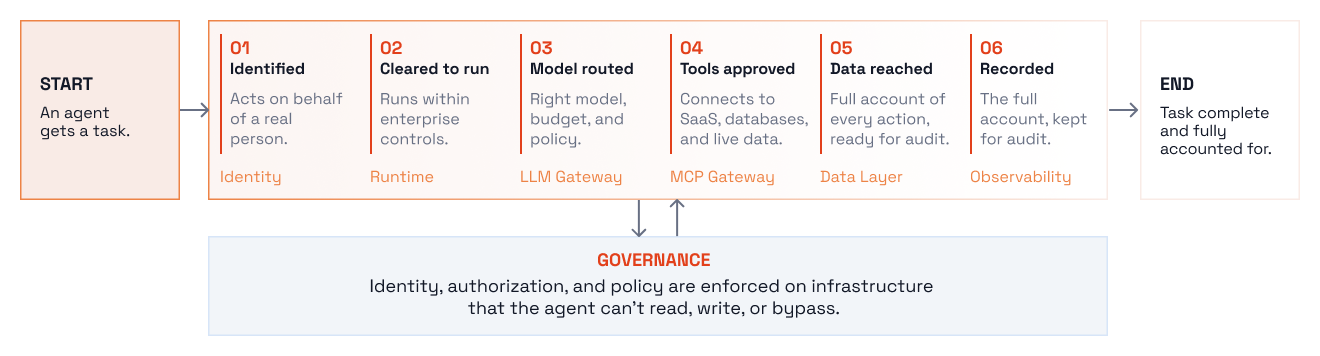
Any credible Agentic Data Plane, regardless of vendor, must provide six layers:
Any vendor missing one of these is selling you a piece of the problem.
The six layers above define what any credible Agentic Data Plane must have. Here’s what Redpanda delivers that other vendors can't match.
Most Agentic Data Planes run in the vendor's infrastructure. The governance layer that's supposed to protect your enterprise data lives in someone else's environment. With Redpanda BYOC, the entire Agentic Data Plane (agents, governance, MCP gateway, data access layer) deploys into your own VPC on AWS, GCP, or Azure. Your data never leaves your environment, and your security team controls the perimeter. You get fully managed infrastructure without the data sovereignty tradeoff.
First-party Redpanda agents, the agents you bring, and the tools your people already use are all governed from a single view, each with its own identity, cost, and activity trail.
But getting those agents connected to the rest of your stack is where most teams hit a wall. Every integration with Salesforce, Workday, ServiceNow, or internal Postgres shouldn’t require a custom build.
The Redpanda Agentic Data Plane ships a catalog of managed MCP servers for the systems your business runs on, configured through the UI rather than written from scratch. Teams that already run their own MCP servers can register them in the same catalog. They inherit the same governance whether Redpanda hosts the server or you do.
When an agent pulls a customer record from Salesforce or files a ticket in ServiceNow, the action has to run under the requesting user's identity. Anything less and your audit log says "the agent did it," which tells you nothing. Real OBO means the user's token, scoped even more narrowly than the original user's permissions, flows through the agent to the downstream system, with the agent's own identity layered on top. The Redpanda Agentic Data Plane issues per-agent identities and brokers token exchange at the MCP gateway, recording both identities on every call. Your existing IAM remains the source of truth. The agent inherits permissions instead of bypassing them.
Most Agentic Data Planes hand-wave this. Some run agents under service accounts with broad permissions and call it "agent identity." Others wire up an OAuth flow once, cache the token, and reuse it across every user the agent serves. Both shortcuts collapse the chain of authority. The audit log can't tell you which human authorized a given action, downstream systems can't apply that human's permissions, and a single overprivileged token becomes the agent's blast radius for every user it touches. Real OBO requires token exchange at every hop, scoped to the requesting user, with the agent's identity attached separately so you can see both.
A lot of the ecosystem is betting on agents that discover tools at runtime and assemble a workflow on the fly. It demos well. But it's wrong for enterprise. Compliance and security must sign off on an agent's toolset before it runs. An agent that picks its own tools is an agent whose blast radius you can't bound or reproduce. Every agent in the Redpanda Agentic Data Plane (declarative or bring-your-own) is configured with an explicit set of tools and data sources at registration. The MCP gateway enforces that set at runtime, denies anything outside scope, and logs the attempt. That means agents behave the same way on Tuesday as they did on Monday.
Most Agentic Data Planes treat data access as a request-response problem. An agent asks, and a tool answers. That works for static records. It breaks when your agent needs the current state from systems that change continuously: orders, transactions, support tickets, inventory. Redpanda's data integration layer is built on the same streaming infrastructure that already moves real-time data through your enterprise. Agents get a live view instead of a stale snapshot.
Dashboards, transcripts, guardrail enforcement, and policy controls in one place. You can see which agents exist, what each is connected to, how much it costs, where it's failing authorization checks, and which are quietly going unused. The view covers every agent and every MCP server in the environment, whether Redpanda built them or you did.
Just as A2A is the standard protocol for agent to agent communication, MCP gives you one protocol for agent-to-tool communication. OpenTelemetry gives you one trace format, OAuth and OIDC give you identity flows that work across vendors, and the Apache Kafka® protocol for streaming data. The Redpanda Agentic Data Plane is opinionated about implementation and unopinionated about the ecosystem it lives in. Bring your own models, your own agents, your own SaaS, your own IDP. The platform governs all of it the same way.
Deploying chatbots for yourself is easy. Low-stakes, limited reach, and with a human overseeing every step. Deploying autonomous agents for the enterprise is an entirely different category. They will act faster, touch more systems, and carry real authority.
This is the gap that keeps most enterprise AI stuck in “single player” mode.
The question isn't whether you need a governed layer between autonomous agents and everything they reach. That answer is a resounding “Yes.” The real question is whether you build it right the first time: open standards, independent of the model vendor, covering all six layers—or whether you discover what you missed when an agent misbehaves in production, and your audit log doesn't say anything useful.
The Agentic Data Plane is how you build it right.
-> Explore the Redpanda Agentic Data Plane
-> The four pillars of agent governance at scale
-> [Video] Governing enterprise agents in production
-> The importance of Out-of-Band Metadata for safe autonomous agents
Good intentions don’t work. Mechanisms do.
What two security operators learned from a decade of building at petabyte scale
What architects are asking about governance, data access, and control for enterprise agents
Subscribe to our VIP (very important panda) mailing list to pounce on the latest blogs, surprise announcements, and community events!
Opt out anytime.