


Comparing Apache Kafka alternatives









Apache Kafka alternatives: a comparison guide
Picking a streaming platform is not just about throughput benchmarks. It is about what you'll deal with at 2 AM when something breaks: how well you understand the system, how quickly you can restore it, and whether the data you need is recoverable. It is also about core reliability and stability, lowering the chance that anything breaks at 2 AM in the first place. Those are production concerns, and they vary significantly across platforms.
Apache Kafka® is the standard. It defined the category, and its protocol has become the interface that the rest of the ecosystem builds against. But it is not always the right choice. Alternatives have matured significantly, and the market is consolidating in meaningful ways. Cloud providers are building proprietary streaming services. Startups are challenging Apache Kafka’s architecture assumptions. The Apache Kafka ecosystem itself is evolving with new storage and replication capabilities. Not all of these platforms speak the same protocols, not all handle disaster recovery natively, and not all will fit your operational model.
This guide covers ten platforms (Apache Kafka, Redpanda Streaming, Confluent Cloud and Confluent’s WarpStream offering, Apache Pulsar, RabbitMQ, NATS/JetStream, Amazon Kinesis, Google Pub/Sub, and Redis Streams) with enough architectural depth to make an informed production decision.
Platform overviews
Let’s consider each platform below with a concise architectural overview covering its core design, deployment model, and where it fits in the streaming landscape.
Apache Kafka
Apache Kafka is a distributed commit log built around immutable, partitioned, ordered sequences of records called topics. Producers write to partitions and consumers read from them at their own pace using offsets. This model decouples producers from consumers in a way that queue-based systems do not, which is why Apache Kafka became the backbone of so many event-driven architectures.
Apache Kafka historically required ZooKeeper to manage cluster metadata and leader election. Since Apache Kafka 4.0 (released March 2025), ZooKeeper support has been entirely removed and KRaft (Apache Kafka’s own Raft-based consensus implementation) is now the only supported metadata mode. The broker is written in Java and Scala, which means JVM tuning (heap sizes, garbage collection settings, thread pools) is a permanent part of operating it.
Apache Kafka is self-managed by default, though third-party managed offerings exist through Amazon MSK, Confluent, Aiven, and others. Protocol-wise, the Kafka protocol is the de facto standard that every other platform in this guide gets measured against.
Redpanda Streaming
Redpanda Streaming is built for full Apache Kafka API compatibility. It ships as a single binary written in C++ (avoiding garbage-collection pauses and JVM heap tuning), uses a thread-per-core model via the Seastar library, and uses Raft for consensus. The result is a high-performance platform designed to reduce CPU and memory overhead, with better throughput, lower latency, and lower operational overhead than a traditional Apache Kafka cluster.
Deployment options include self-managed (bare metal, Kubernetes, VMs) and Redpanda Cloud, which offers Serverless, Dedicated, and BYOC (bring your own cloud) tiers. Because Redpanda Streaming is fully Kafka API-compatible, existing producers and consumers, connectors, and Schema Registry clients connect without code changes. BYOC deployment offers specific advantages: since customers provision the infrastructure in their account, they can use their cloud vendor discounts and credits, as well as their networking and security architectures. Data stays within the customer’s governance boundary.
Redpanda Streaming’s single-binary model means no JVM heap to tune and no stop-the-world pauses. Teams that have spent meaningful time maintaining an Apache Kafka cluster tend to notice the reduced operational surface.
Confluent: Two products, two architectures
Confluent occupies a different position in this guide than the other eight platforms, because "Confluent" is not a single architecture. It is now a vendor with two distinct, separately branded, separately priced products that market comparisons frequently conflate: Confluent Cloud and WarpStream.
Confluent Platform was the original self-managed data streaming solution, which can run on-premises or self-managed in the cloud. Confluent Cloud is Confluent's fully managed cloud-based Kafka service. It runs a broker-based, disk-backed architecture powered by Confluent's Kora engine. This service evolved from Apache Kafka, with proprietary additions like Stream Governance, fully managed connectors, and its own tiered storage implementation. Operationally, it behaves like a traditional managed SaaS: customers select a cluster type, cloud provider, region, and networking model, and Confluent handles broker provisioning, patching, and upgrades. Cost shows up as a single vendor invoice, with the trade-off that the customer gives up direct visibility into (and control over) the underlying infrastructure.
WarpStream, which Confluent acquired in September 2024, is architecturally unrelated to Confluent Cloud. It was built from scratch as a diskless, Kafka-protocol-compatible system: stateless Agent processes handle the protocol layer, and object storage (S3 or an equivalent) is the only durable data layer. There is no broker-local disk and no inter-broker replication to manage. WarpStream is typically deployed BYOC-style, meaning the customer runs the agent fleet inside their own cloud account, on their own cloud bill, while Confluent operates the control plane and metadata coordination as a managed service on top. Confluent has positioned WarpStream as complementary to Confluent Cloud rather than a replacement, aimed at large-scale, relaxed-latency workloads such as logging, observability, and feeding data lakes.
Since IBM completed its acquisition of Confluent on March 17, 2026, both products continue to operate under the Confluent brand as a wholly owned IBM subsidiary. That change affects the corporate ownership chain (IBM → Confluent → WarpStream), but it does not merge the two products: Confluent has been explicit that WarpStream is not simply a BYOC tier of Confluent Cloud. They remain separate products with separate architectures, separate consoles, and separate pricing models. Buyers evaluating "Confluent" should treat that as two separate evaluations, not one. However, most large customer environments today are complex, with strict-latency SLA workloads running right beside relaxed-latency workloads. In practice, this means customers need to purchase and operate both.
For engineers scoping Confluent as an option, the practical distinction comes down to where infrastructure — and its cost — is visible:
- Confluent Cloud fits teams that want the broadest managed ecosystem (Stream Governance, fully managed Flink/ksqlDB, fully managed connectors) and are comfortable trading cost transparency and infrastructure control for operational abstraction. Nearly all of the cost shows up on one vendor invoice.
- WarpStream fits teams that want object-storage economics and want the data plane to stay inside their own cloud account and VPC boundary, but with materially higher end-to-end latency than a disk-backed broker.
Apache Pulsar
Apache Pulsar uses a layered architecture that separates compute from storage. Brokers handle client connections and message routing, while Apache BookKeeper handles durable storage. This separation gives Pulsar genuine elasticity (you can scale brokers and storage independently), but it also doubles the operational surface area because you are running two distributed systems.
Pulsar has its own native protocol. Kafka compatibility is available through KoP (Kafka on Pulsar), a translation layer that intercepts Kafka protocol traffic and maps it to Pulsar semantics. KoP is a protocol translator, which means edge cases around transactions, exactly-once semantics, and certain admin APIs have historically surfaced behavioral deltas between KoP and native Apache Kafka. Teams that need complete Kafka ecosystem compatibility should test their specific workloads carefully. StreamNative, a commercial vendor of Pulsar, offers the Ursa engine, which supports both Apache Pulsar and Apache Kafka simultaneously and allows protocol translation between the two.
Deployment is self-managed, with StreamNative providing a managed offering. Pulsar’s geo-replication is a native architectural feature and one of its genuine differentiators.
RabbitMQ
RabbitMQ is a message broker built around Advanced Message Queuing Protocol (AMQP), which provides exchanges, bindings, and queues with rich routing semantics (direct, fanout, topic, headers). Traditional RabbitMQ queues are typically consumed and deleted, making them excellent for task queues, work distribution, and complex routing scenarios, but not ideal for data durability or replayability. RabbitMQ also offers Streams, an append-only log abstraction with replayable consumption, but its core ecosystem and architecture remain centered on messaging and routing rather than Kafka-like event streaming.
For teams that need to bridge NATS into the broader streaming ecosystem, Redpanda Connect provides a NATS connector that moves data between NATS and other systems without custom glue code. NATS excels in edge, IoT, and latency-sensitive use cases where reduced operational overhead outweighs the narrower ecosystem. Managed deployment is available through Synadia Cloud.
NATS / JetStream
NATS is a lightweight pub/sub messaging system designed for simplicity and low latency. The core NATS server is genuinely small and fast. JetStream, the persistence layer built on top of NATS, adds durability, consumer groups, and acknowledgment semantics, bringing it closer to streaming.
NATS uses its own protocol with no Kafka compatibility layer, which creates friction if your existing tooling assumes Kafka semantics (offsets, partitions, consumer groups as Apache Kafka defines them). JetStream implements similar concepts but with different APIs and different operational behavior. NATS excels in edge, IoT, and latency-sensitive use cases where reduced operational overhead outweighs the narrower ecosystem. Managed deployment is available through Synadia Cloud.
Amazon Kinesis
Amazon Kinesis Data Streams is a fully managed, shard-based streaming service native to AWS. You define shard counts upfront (or use on-demand mode), and AWS handles everything else (replication, durability, patching). The API is proprietary, so your producers and consumers use the Kinesis SDK or KCL rather than Kafka clients. Kinesis is managed-only with no self-hosted version, and obviously only runs on AWS.
The trade-off is vendor lock-in. Moving off Kinesis means rewriting your producers, consumers, and any stream processing code. If you are building greenfield on AWS and do not expect to move, or to ever run in an on-premises, hybrid cloud, or multi-cloud environment, that is often an acceptable trade. If you have existing Apache Kafka tooling or need portability, it is worth weighing carefully.
Google Pub/Sub
Google Pub/Sub is Google Cloud’s fully managed, serverless messaging service. It scales automatically, uses a global endpoint by default, and requires no capacity planning. Like Kinesis, it uses a proprietary API (the Pub/Sub client libraries, rather than Apache Kafka clients). Apache Kafka-to-Pub/Sub connectors exist for bridging workloads, but this is connector-based integration rather than native Apache Kafka protocol support. Google previously offered Pub/Sub Lite as a lower-cost alternative with Apache Kafka migration tooling, but Pub/Sub Lite was deprecated in 2024 and is no longer available to new customers. Teams already on Apache Kafka will face meaningful rework to move workloads to standard Pub/Sub.
Pub/Sub’s serverless model means you never provision capacity, which is genuinely useful for unpredictable workloads. The trade-off is the same as Kinesis: buying into Google Cloud’s ecosystem with an API that has no portable alternative. On-premises, hybrid cloud, or multi-cloud deployments are impossible.
Redis Streams
Redis Streams is a data structure built into the Redis ecosystem that implements an append-only log with consumer groups. It was designed to be both an upstream data source and a downstream data sink for Redis, an in-memory key-value NoSQL database. That architecture defines both its strengths and its limits.
Redis Streams fits lightweight, low-latency use cases where your team already runs Redis and does not need high-throughput durable streaming. Durability depends on Redis’s AOF or RDB persistence configuration, which carries trade-offs around performance and recovery time. Deployment options include self-managed Redis and Redis Cloud.
For high-throughput workloads where persistence, replication guarantees, and long-term retention matter, Apache Kafka, or an Apache Kafka-compatible alternative like Redpanda Streaming, is the more appropriate choice. Likewise, if you are running a polyglot, heterogeneous environment with many data sources and destinations, and Redis is not at the gravitational center of your data architecture, then Kafka, or a Kafka-compatible service, would be a more appropriate solution because of its rich ecosystem of connectors.
Deep-dive comparisons
The following sections compare all eight platforms across the dimensions that matter most in production: protocol compatibility, tiered storage, cloud object storage, disaster recovery, encryption, and authentication.
Protocol Compatibility
Protocol compatibility determines how much rework you will face. If your producers and consumers are already Kafka clients (using librdkafka, the Java client, or any connector in the Kafka Connect ecosystem), then switching to a platform that does not speak the Kafka protocol natively means rewriting application code, not just reconfiguring endpoints.
Full native Kafka API compatibility is offered by Apache Kafka itself and Redpanda Streaming. Redpanda’s compatibility is implemented in C++ at the protocol level through a direct implementation rather than a translation layer, which means you point your existing Kafka clients at Redpanda and they work, with a fully compliant Schema Registry, the same Kafka Connect connectors and an even larger library of compatible Redpanda Connect connectors, and a rpk CLI tool as a drop-in alternative to kafka-topics.sh.
Partial or translated compatibility covers Apache Pulsar via KoP. KoP works for a broad range of common use cases, but behavior at the edges (particularly around transactions and exactly-once delivery) can diverge from native Apache Kafka behavior. StreamNative’s Ursa engine supports both Apache Pulsar and Apache Kafka simultaneously and allows protocol translation.
RabbitMQ has no Kafka protocol support at the broker level; integration with Kafka ecosystems requires external connectors.
NATS/JetStream and Redis Streams use their own non-Kafka protocols (NATS uses a documented text-based wire protocol; Redis uses RESP), while Amazon Kinesis and Google Pub/Sub expose proprietary cloud APIs. Moving to any of these from an Apache Kafka deployment means rewriting your producers, consumers, and likely your stream processing logic.
Tiered Storage
Tiered storage solves a real cost problem at scale. If you retain 30 days of events at high throughput, you are either sizing your broker nodes for peak storage (paying for the disk even when you do not need the compute) or running into retention limits. Tiered storage automatically offloads older log segments to object storage (S3, GCS, Azure Blob) while keeping recent data on local disk for low-latency access.
Apache Kafka introduced tiered storage through KIP-405 in Apache Kafka 3.6 and declared the feature production-ready in Apache Kafka 3.9. The architecture uses a pluggable RemoteStorageManager, and upstream Apache Kafka does not ship a production object-storage implementation, so self-managed deployments need to supply or adopt a compatible implementation. Managed offerings (Confluent, Aiven) provide their own production-grade storage backends.
Redpanda Streaming treats tiered storage as a core capability. Setting cloud_storage_enabled: true activates automatic log segment offloading to S3, GCS, Azure Blob Storage, or Azure Data Lake Storage. Consumers read from either local or object storage through the same API with no difference in how you query historical data. Redpanda formalizes this with three explicit storage modes: local (local disk only), tiered (local disk plus object storage offload), and cloud (primary storage is object storage, also known as Cloud Topics). The system does not delete a local segment until the remote copy is confirmed available.
Confluent Cloud also offers tiered storage as a core part of its service. Similar to Redpanda, queries across both “hot” (local) and “cold” (object) storage are transparent. However, it does not natively offer a fully object storage-based option. Instead, users need to use WarpStream (see below under Cloud Object Storage and Cloud Topics).
Apache Pulsar has tiered storage built into its architecture through data offloaders. Because BookKeeper is already the storage layer, offloading older segments to S3 or GCS is a natural extension. This is one area where Pulsar’s layered design pays off operationally.
RabbitMQ has no production tiered storage concept today. Queues live on disk, and if you fill it you have a problem, with no object storage integration available. There is work underway to add tiered storage to Osiris, the log implementation behind RabbitMQ Streams, but it is not yet a shipped capability.
NATS/JetStream provides an object store API and configurable stream retention, but without automatic cloud-tier offloading. JetStream streams are bounded by the storage you provision.
Amazon Kinesis retains data for a configurable period (up to 365 days with extended retention), but it offers no user-accessible object storage tier. Older data is either retained in the service or expired, and you cannot access it through an object storage API.
Google Pub/Sub handles retention internally with no user-visible tiered storage model. Retention is time-bounded and managed by Google.
Redis Streams has no tiered storage. Data lives in memory, and persistence (AOF/RDB) is a durability mechanism rather than a cost-optimization tier. Since Redis is an in-memory database offering extremely low latency, and object storage is a high-latency medium, using object storage directly with Redis is an antipattern.
Cloud Object Storage and Cloud Topics
Tiered storage only uses object storage as an overflow destination. Recent data stays on local disk. It differs from cloud object storage used as a primary tier. In this latter case, the topic exists only in object storage from the start, with no local disk footprint. The two models have different operational and cost profiles.
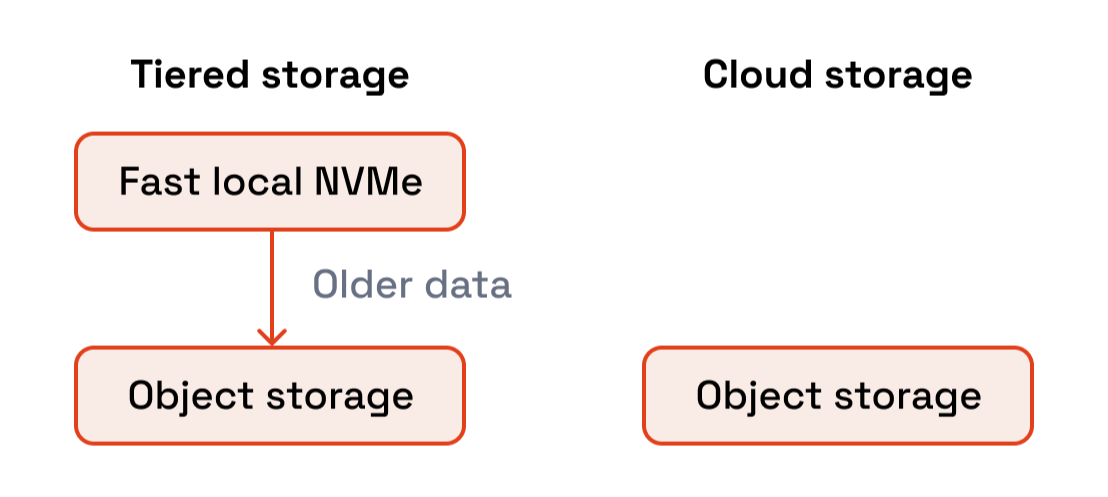
Redpanda Streaming’s cloud storage mode is known as Cloud Topics. The economics change significantly because you pay object storage rates rather than NVMe SSD rates for your full retention window. However, you do accept higher read latency, which makes this model better suited for high-retention, infrequently accessed historical data than for hot streaming workloads that need sub-millisecond local reads.
Apache Kafka has outlined Diskless Topics in KIP-1150, which would enable a similar capability. KIP-1150 has been accepted by the Apache Kafka community, but it is a meta-KIP that establishes architectural direction rather than a production-ready implementation. The actual engineering work for upstream Kafka remains in its early stages and is not something you can deploy today in vanilla Kafka.
Confluent’s WarpStream takes a different architectural approach, serving as a Kafka-compatible platform where object storage is the primary persistence layer by design, with stateless agents handling the protocol layer.
It's worth being precise about what "Confluent" means in this context, though: WarpStream is a separate product from Confluent Cloud, Confluent's original broker-based managed Kafka service. Confluent Cloud does not itself run on the object-storage-primary model described above. It is a disk-backed, broker-based architecture with its own separate tiered-storage implementation, closer in kind to the Kafka model than to WarpStream's. If a comparison is evaluating "Confluent's" cloud-topics story, it needs to name which of the two products it means, since only WarpStream fits this category. StreamNative’s Ursa engine, AutoMQ, and Bufstream are other entrants in this space, offering cloud-native Apache Kafka implementations backed by object storage.
Apache Pulsar, RabbitMQ, NATS/JetStream, Kinesis, Pub/Sub, and Redis Streams do not offer a comparable cloud-topic model where object storage is the primary storage tier for a running stream.
Disaster Recovery
Disaster recovery comes down to what happens when a rack in your datacenter, an entire datacenter, or even the whole availability zone or region your cluster runs in goes offline. The answers vary more dramatically across these platforms than most engineers expect.
Apache Kafka does not include cross-cluster replication in the core project. A utility known as MirrorMaker 2 (MM2) handles this, but it is a separate component with its own deployment, monitoring, and operational burden. Offset translation between clusters is imperfect (consumer group offsets in the source cluster do not map cleanly to the target cluster without careful configuration), so MM2 is functional but not frictionless.
Redpanda Streaming addresses this with Shadowing, an enterprise feature available on BYOC Dedicated, and Self-Managed cluster. Shadowing creates an active-passive relationship between a source cluster and a shadow cluster, replicating topic data, consumer group offsets, ACLs, topic configurations, and Schema Registry data while preserving byte-for-byte records with original offsets and timestamps. The architecture is asynchronous and pull-based, so DR replication does not add latency to production writes. In a failure scenario, shadow clusters take over: shadow topics can be promoted to writable. Shadow links are manageable through the Redpanda Cloud UI, the Cloud API, or rpk.
Confluent Cloud offers Cluster Linking for disaster recovery. It also offers offset preservation, plus replicates ACLs and schema registry. While streaming data updates take a few seconds, cluster metadata update delays are 30 seconds by default (modifiable using the consumer.offset.sync.ms variable).
Warpstream offers WarpStream Orbit, another offset-preserving disaster recovery solution. Note that it requires object storage to remain available; services like AWS S3 rarely do go offline, but global or region-wide outages occur only once every few years. A network outage that prevents access to regional object storage is more likely. In case of a regional network or object storage outage, WarpStream re-routes requests to a different object storage region.
Apache Pulsar has native geo-replication, meaning geographically separate clusters can update each other in an active-active architecture with bidirectional sync. Replication between clusters in different regions happens in the background and is configured at the namespace level. This is part of the core product, not an add-on. This is a genuine architectural advantage for globally distributed deployments and organizations.
Amazon Kinesis is a regional service with no provider-managed cross-region replication. Building a DR architecture for Kinesis means designing your own cross-region replication pipeline, typically using Lambda consumers or Flink applications that read from a primary stream and write to a standby stream in another region. AWS provides reference architectures, but you own the replication logic and failover orchestration.
Google Pub/Sub provides built-in cross-zone durability within a region, synchronously replicating messages across multiple zones. However, regional failover is not automatic: workloads that need resilience to a full regional outage must deploy publishers and subscribers across regions and implement an appropriate failover or redundant-publishing strategy.
NATS/JetStream supports geo-distributed deployments through super-clusters, but this requires explicit configuration and operational knowledge rather than anything automatic.
RabbitMQ provides Shovel and Federation plugins for cross-cluster message transfer, but there is no native geo-replication. Building DR on RabbitMQ requires explicit topology design and ongoing operational management.
Redis Streams relies on Redis Cluster for intra-region HA and Redis Sentinel for failover, but cross-region DR requires active-active or active-passive replication setups that you design and operate yourself.
Encryption
Compliance and security requirements often mandate encryption both in transit and at rest. These are different concerns with different implementations across platforms.
In Transit
All eight platforms support TLS for data in transit, but the configuration experience differs.
Apache Kafka requires TLS to be configured per-listener in the broker configuration. It is supported and well-documented, but not enabled by default in self-managed deployments, so you bring your own certificates.
Redpanda Streaming encrypts all traffic using TLS 1.2 or 1.3, with certificates signed by Let’s Encrypt and mitigations against endpoint enumeration via certificate transparency logs. In self-managed Kubernetes deployments using the Helm chart, TLS is enabled by default for all internal and external listeners, with certificates managed by cert-manager. Self-managed deployments outside Kubernetes require explicit TLS configuration, similar to Apache Kafka.
Confluent encrypts traffic using TLS 1.3, with a fallback to TLS 1.2 depending on the client connection. If using self-managed encryption keys, Confluent recommends Client-Side Field Level Encryption (CSFLE), which only encrypts specific fields. It can also be configured to use Client-Side Payload Encryption (CSPE), which encrypts the entire payload.
WarpStream sends data in plain text by default, but can be configured to use TLS and optionally mutual TLS (mTLS).
Apache Pulsar, RabbitMQ, and NATS/JetStream all support TLS, configured per-deployment with your own certificates, and none enable it by default in self-managed setups.
Amazon Kinesis and Google Pub/Sub enforce TLS on all connections. You cannot disable it, and you do not configure it. This is another area where managed-only means the provider handles security baseline configuration.
Redis Streams has supported TLS since Redis 6.0, but it must be explicitly enabled and configured.
At Rest
Encryption at rest is where the platforms diverge more significantly.
Apache Kafka stores log segments on disk in plaintext and provides no native encryption at rest. Encryption at rest for Apache Kafka means disk-level encryption at the OS or cloud provider level (dm-crypt on Linux, EBS volume encryption on AWS, and so on). This is an important and commonly misunderstood gap. If your compliance requirements mandate application-level or broker-level encryption at rest, Apache Kafka does not satisfy that natively.
Redpanda Cloud uses the cloud provider’s default volume encryption (AES-256) for broker disk. For Tiered Storage and Cloud Topics data in object storage, each Redpanda Cloud cluster uses a unique, periodically rotated managed master key via SSE-S3 with AES-256 encryption. Self-managed Redpanda deployments follow the same pattern as Apache Kafka, relying on disk encryption at the infrastructure level.
Confluent Cloud uses the cloud provider’s default encryption as well. Self-managed Confluent Platform relies on operating system- or disk-level encryption.
WarpStream relies on the underlying object storage system (S3, for example) to provide encryption at rest.
Apache Pulsar also has no native broker-level encryption at rest. BookKeeper stores ledger data on disk without encryption. Message-level encryption is available as a client-side feature (producers encrypt payloads before publishing), but this differs from storage-layer encryption, and disk encryption at the OS level is the typical approach for compliance requirements.
RabbitMQ and NATS/JetStream have no native encryption at rest for their persistent data. Disk encryption is required at the infrastructure layer.
Amazon Kinesis encrypts data at rest using AWS KMS by default, with server-side encryption included and configurable.
Google Pub/Sub encrypts all stored data at rest using Google-managed keys by default, with CMEK (Customer-Managed Encryption Keys) available for additional control.
Redis Streams has no native encryption at rest for in-memory data. Persistent data written via AOF or RDB relies on OS-level disk encryption.
Authentication and Authorization
Controlling which clients can produce and consume from which topics is a core security requirement, especially in multi-team environments where teams share cluster infrastructure.
Apache Kafka supports SASL (PLAIN, SCRAM-SHA-256, SCRAM-SHA-512, GSSAPI/Kerberos, OAUTHBEARER) and mTLS for authentication. Authorization uses ACLs, which are per-principal, per-resource, and per-operation. The model is functional but granular, and managing ACLs at scale across many topics and principals requires tooling or automation.
Redpanda Streaming supports the same SASL mechanisms as Apache Kafka, plus mTLS. RBAC (role-based access control) and GBAC (group-based access control) is available in the Enterprise tier, providing higher-level abstractions over raw ACLs. Redpanda Cloud adds identity-based access control tied to your organization’s identity provider (IdP), including SSO via OIDC and OAuth 2.0. Access tokens are encrypted at rest using AES-256 GCM and never leave the customer network. Redpanda also supports Kerberos via GSSAPI.
Confluent Cloud provides RBAC and ACLs. However, it does not support GBAC. Users are authenticated either by basic auth (user ID and password) or SAML-based SSO (such as Okta) using OIDC and OAuth 2.0. It does not support Kerberos.
Warpstream supports RBAC and ACLs. It also supports SAML-based SSO. It does not support Kerberos.
Apache Pulsar has a multi-layered auth model supporting JWT tokens, mTLS, Kerberos, and OAuth2 for authentication, with built-in RBAC for authorization. The authorization model is more expressive than raw Apache Kafka ACLs, which is one of Pulsar’s stronger security stories.
RabbitMQ supports username/password authentication, TLS client certificates, LDAP integration, and OAuth2 via a plugin. The built-in permissions model covers configure, write, and read permissions per vhost and resource. For most use cases, RabbitMQ’s auth story is adequate. For complex multi-tenant scenarios, the vhost isolation model becomes the primary tool.
NATS/JetStream uses a decentralized authentication model based on NKeys (Ed25519 key pairs) and JWT-based credentials. The operator/account/user hierarchy is distinctive: accounts provide isolation boundaries, and users within an account have their own credential scopes. TLS and username/password are also supported for simpler deployments. The model is powerful but requires understanding the NATS identity hierarchy.
Amazon Kinesis uses AWS IAM exclusively. Producers and consumers authenticate with IAM roles or users, and IAM policies define authorization. If your team already manages AWS IAM, this integrates naturally. If you need fine-grained per-stream permissions for non-AWS-native clients, the IAM approach can feel cumbersome.
Google Pub/Sub uses Google IAM in the same way. Service accounts, roles, and bindings control who can publish or subscribe to which topics. Custom roles are available if the predefined Pub/Sub roles do not match your needs.
Redis Streams has ACLs available since Redis 6.0 (you can restrict users to specific commands and key patterns, including stream keys). Password authentication and TLS client certificates are also supported. The community ACL model is less expressive than enterprise RBAC, which is worth evaluating if you have strict multi-tenant access requirements.
Comparison table
How to choose the right streaming platform
The decision is about matching platform characteristics to your specific situation. Finding the best platform in the abstract is a separate exercise with no clean answer.
If you are already running Apache Kafka and want to reduce operational complexity, Redpanda Streaming is the natural answer. It is fully Kafka API-compatible, so you change endpoints rather than application code. You eliminate the JVM and the overhead that comes with it.
If you are building greenfield on AWS exclusively and want zero infrastructure management, Amazon Kinesis fits this profile. Accept that you are buying into the AWS SDK, that your producers and consumers are portable only within AWS, and that cross-region DR is your responsibility to design (Kinesis is a regional service with no built-in cross-region replication). If those trade-offs are acceptable for your organization, Kinesis removes a real operational burden.
If you are building in GCP exclusively and want serverless scalability, Google Pub/Sub makes the same trade-off as Kinesis, giving you zero infrastructure, global scale, and a proprietary API. The auto-scaling is genuine (you do not provision capacity), which makes it a good fit for workloads with unpredictable traffic patterns.
If you need complex message routing and queue-based workload distribution, RabbitMQ is designed for this. Topic exchanges, fanout routing, priority queues, and dead-letter exchanges let RabbitMQ handle routing scenarios that a log-based platform like Apache Kafka handles awkwardly. Understand that you are building a message bus rather than a streaming platform.
If you are working on edge, IoT, or latency-sensitive pipelines, NATS/JetStream is worth evaluating. The server footprint is small, latency is excellent, and the operational model is simpler than Apache Kafka. Accept the non-Kafka protocol and the different operational semantics compared to Kafka consumer groups.
If you already run Redis and need lightweight stream processing, Redis Streams is reasonable for low-throughput use cases where persistence requirements are modest and your team already understands Redis operational behavior. The in-memory architecture and persistence trade-offs put it in a different category from Apache Kafka, and it should not replace Apache Kafka in high-throughput, durability-critical pipelines.
If you need native geo-replication and are willing to operate a two-tier distributed system, Apache Pulsar’s geo-replication capability is genuinely native and well-implemented. The cost is operational: you run both Pulsar brokers and a BookKeeper cluster, with the associated complexity. That complexity is manageable (StreamNative offers managed Pulsar) but it is more than you take on with a single-binary deployment model.
If Confluent is on your shortlist, evaluate Confluent Cloud and WarpStream as two separate decisions, not one. Confluent Cloud is the fit if you want the broadest managed ecosystem and are comfortable with infrastructure abstraction and a single vendor invoice. WarpStream is the fit only for large-scale, latency-tolerant workloads (logging, observability, data lake ingestion) where object-storage economics and keeping the data plane in your own cloud account outweigh the current lack of transactions and compacted-topic support, and the higher end-to-end latency inherent to a diskless design. Don't let a vendor's single brand umbrella substitute for evaluating the two architectures on their own merits.
Conclusion
The mistake most teams make when evaluating streaming platforms is leading with benchmark numbers or lowest cost. Throughput figures matter, but they are table stakes. The lowest absolute upfront price may cost you enormously in staff headaches, reliability, and production capabilities. The questions that actually drive production decisions are operational: how little or much it misbehaves in production, whether you can satisfy your compliance team’s encryption and authentication requirements without bolting on external tooling, whether it is a natural architectural fit for your environment, and what recovery looks like when a region goes offline and how much of that is your responsibility versus the platform vendor’s.
Protocol compatibility, operational model, and security requirements should anchor your evaluation. If you need Kafka ecosystem compatibility and a simpler operational story, Redpanda Streaming deserves serious attention.
If you are committed to a single cloud provider and want zero infrastructure work, Kinesis or Pub/Sub are defensible choices, though go in clear-eyed about the API lock-in. If your primary use case is message routing rather than event streaming, RabbitMQ is the right tool, and you should not force a log-based platform into that role.
And if a vendor comparison lumps "Confluent" together as one line item, treat that as a signal to dig deeper. Confluent Cloud and WarpStream solve different problems with different architectures.
For deeper dives into the platforms most relevant to your situation, consult the official documentation for each. If Redpanda looks like a fit, browse the Redpanda Streaming documentation or sign up for a free trial to start streaming in seconds.
[CTA_MODULE]