Autonomy means sending the model to the data, not the data to the model
Agents put code in control of the whole flow. For the enterprise, that only works with open protocols, a durable log and private data that never leaves its own cloud.


As enterprises enter a world of autonomy, where agents rather than hand-written code paths control the end-to-end flow, developer experience decides the outcome. Either engineers are empowered to build these applications inside the company, or data gets shared outside it: 38% of workers share sensitive work information with AI tools without their employer's knowledge.
Redpanda's take on autonomy, true to its roots as an infrastructure company, is tooling that scales and gets out of the engineer's way. That reduces to a few essentials: connectivity to data, internal systems and models using open protocols; durable execution for agent-to-agent communication; and a simple way to glue it together. First, a systems engineering view of how we got here.
From batch to continuous computation
Twenty years ago we were struggling with data: its volume, speed and size, and how to index it. Most companies ran single-node databases that sometimes had backups. In 2006 we called data the new oil. Like crude oil it was valuable, but distilled insight was the goal, and that required processing. We stitched together open-source projects to scale, adapted multi-armed bandit algorithms to work online, and revenue grew, but so did the operational burden of running these systems.
What we wanted, even if it wasn't obvious to leaders at the time, was a fully managed service that absorbed that complexity at a good price-performance. The industry delivered the separation of compute and storage: infinitely scalable systems with fine-grained security controls. But we gave up ownership of, and convenient access to, our own data. It sat behind a vendor's batch API, and spend became a new explicit variable for anyone building on it.
Batch and streaming
Batch was the mental extension of the Unix pipe: simple stages you could reason about and debug separately. A simple mental model that scaled, slowly, in large part because we lacked the tools of incremental computation such as differential dataflow and DBSP.
The systems community built a replayable log of events with microbatching. Think of it as microservices consuming and producing to stable APIs like RabbitMQ, Apache Kafka® and Redpanda. When people were done, it felt like turning a database inside out: most businesses looked like control-plane databases, or simply views of the log.
"The truth is the log. The database is a cache of a subset of the log."
Redpanda started from the premise that batch was a historical artifact, a product of missing mental tools and of a lack of intuitive, industrial-grade streaming systems. Batch was a way to manage the limits of the computers we had: full buffer caches, slow and scarce disk, unreliable networks. But the world isn't neatly divided into hourly windows where you add up costs for the accounting system. It's full of complications of time, from late-arriving events and the gap between system time and event time to attackers who forge timestamps to reorder sequences.
Apache Iceberg™ and continuous computation
Today almost nobody cares about the difference between batch and streaming. For years we debated whether streaming was a superset of batch once you added a timer. Then, under customer pressure, the largest data warehouses settled on Iceberg as an open format. With that handshake, the world began to treat data as a continuous computation: use the lakehouse for backfill and the low-latency stream for tailing once you've caught up, and push the complexity into the compute engines.
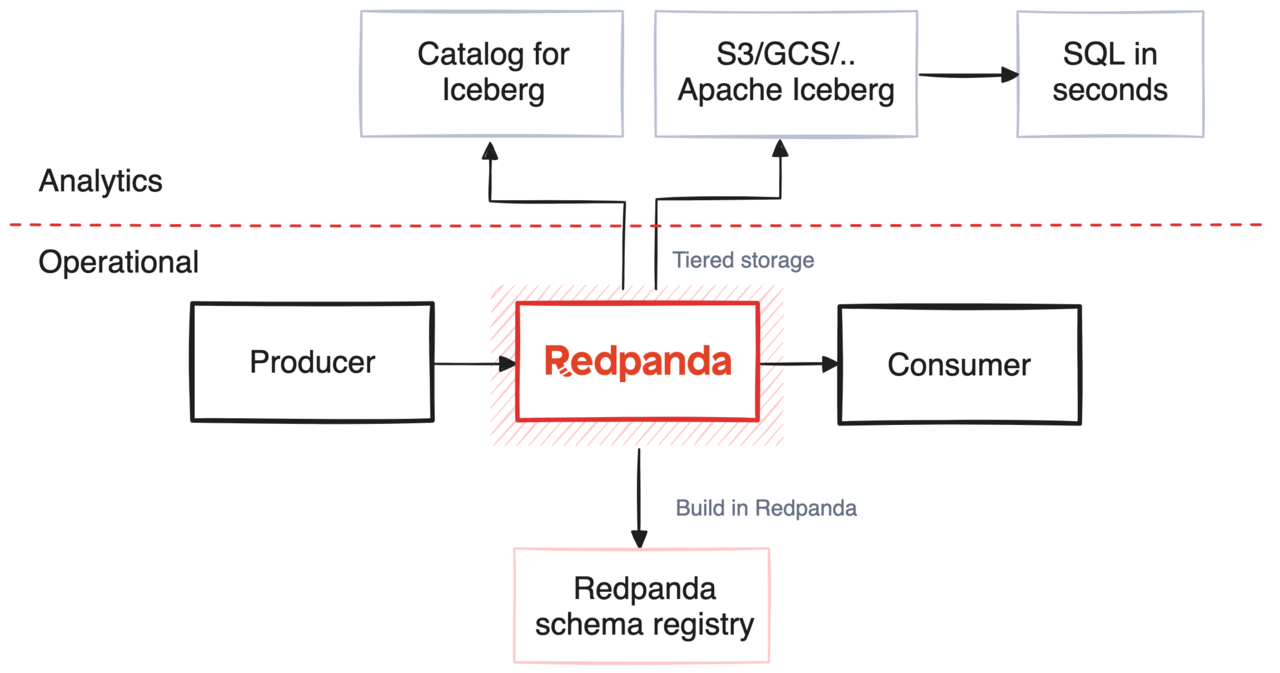
Operational systems like Redpanda removed the need for engineers to care about batch versus real time by providing direct integration with Iceberg. More importantly, they raised the mental model from a bag of bytes to data with schemas, and schema evolution, that warehouses like BigQuery, Databricks and Snowflake can project and consume.
Engineers should now expect the complexity of batch and real time to converge inside the query engine, so the model becomes one continuous computation: one team, one set of access rules, one onboarding and offboarding process, and one open format across all your vendors. Treat infrastructure vendors as materializations of the log, or as views over your data at rest. You remove the cost of running multiple systems and regain ownership of your data in an open format.
For code to control its own end-to-end process, it has to reach that historical data through a tool and also carry the low-latency operational context of the present. It isn't enough to train a model on fraud detection; at the moment of the prompt you must pass it the last five card transactions, spending habits and credit score so it can decide whether a charge is fraud. The real work happens in integration.
Autonomy: code in control of its own process
Autonomy is the new capability that artificial intelligence has given us: code that directs its own end-to-end process. Instead of sending a prompt to a model and getting a one-shot answer, you let the model call functions, choose which database to read, decide how many passes to make and how to divide a task.
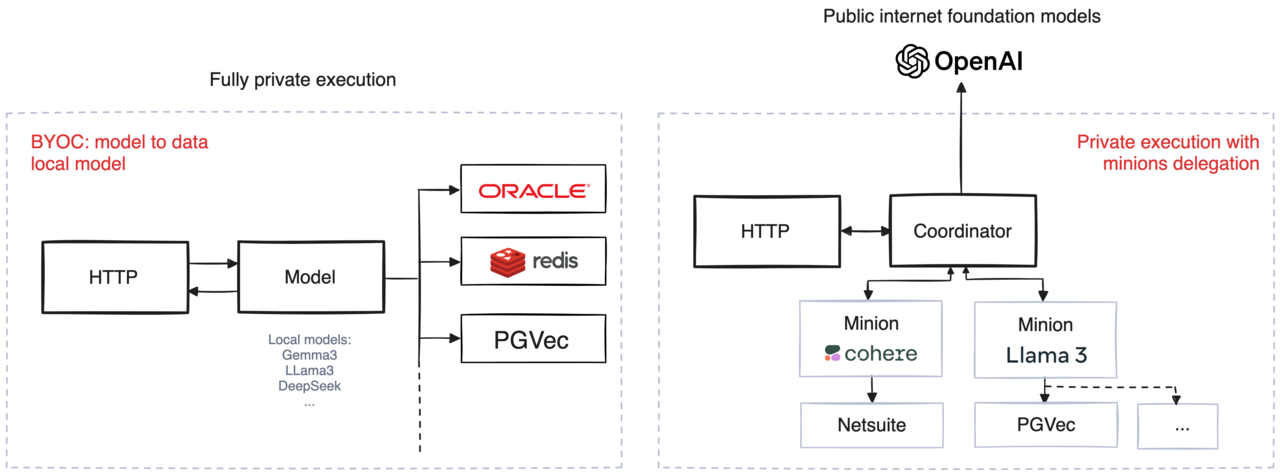
For the enterprise, autonomy carries a heavy price: sharing private data. Most large enterprises don't want to share data, because that data is their advantage. Redpanda's view is that for most of what an enterprise processes, the future is sending the model to the data, not the data to the model. Smaller open models such as Llama 3, Gemma 3, DeepSeek V3 and Phi-4 deliver strong performance on most tasks, often at good-enough quality on a single GPU. Beyond price-performance, they give enterprises control of exactly what data leaves the firewall.
Autonomy is the codifying of business processes with private data, alongside model advances. Public models have already consumed the public data; what they lack is yours. You unlock that either by fine-tuning or by enriching context through retrieval and similar techniques. Private data is the unfair advantage. Sensitive workloads demand end-to-end transparency about how data is transformed, used and protected, and beyond the cost advantage of purpose-built models on your own data (often around a tenth of the cost), there is no better custodian for your data than you.
Frontier models will stay valuable; nothing outside the half-dozen major labs matches their range. But you don't have to choose. A frontier model can orchestrate single-GPU models running on your own network in a minion-style delegation, with the local models working through the private data while the frontier model handles routing and multi-turn planning with its larger context window.
What the infrastructure has to provide
Redpanda's answer, first released in April 2025 as three open-source projects, glues together the developer experience for enterprise agents:
rpk connect mcp-serverexposes Redpanda Connect pipelines, resources and processors as MCP tools for agents to query, so any Redpanda Connect source or destination becomes a tool with a simple configuration.- A Python SDK for writing enterprise agents, with Redpanda Connect tools, record tracing and durability through Redpanda brokers.
rpk connect agentwires MCP tools to your Python agents automatically: it injects the MCP server address, discovers and launches the tools and pipelines, and exposes them as simple HTTP endpoints. You start it withrpk connect agent run.

The SDK focuses on durable execution, automatic log and metric collection with optional full persistence, and access to Redpanda Connect's roughly 300 connectors as an MCP server, with programmatic content filtering for very fine-grained access control.
Three pillars of agent infrastructure
- A distributed log for durable execution, human-in-the-loop workflows, agent-to-agent communication, trace capture, evaluation replay, logs, metrics, collaborative threads, message sampling, analytics, explainability of actions and time-travel debugging.
- An MCP server with about 300 prebuilt connectors that exposes internal tools as simple HTTP endpoints from a YAML config, handling connection pooling, retries, exponential backoff, TLS, certificates and authentication.
- A Python SDK that will feel familiar to anyone who has used Pydantic or OpenAI agents: standards-based, with OpenTelemetry, plug-and-play with declarative MCP pipelines, and integrated with Redpanda's BYOC (Bring Your Own Cloud) deployment for sensitive workloads that can't leave your firewall, including identity providers, ACLs and authentication for multi-agent workflows. Progress and roadmap are on GitHub.

Teams that want a consistent Python experience can write their Redpanda Connect YAML in Python using the Starlark subset: Python without imports, so there's no new configuration language to learn. Long-time Redpanda Connect users can keep describing MCP tools as ordinary pipelines in YAML, with extensions and filtering in Bloblang.
MCP is the data layer for agents
MCP is an intent-based, simple HTTP wrapper that hides the complexity of connecting to internal systems: binary protocols, connection pooling, authentication, caching. In Redpanda Connect it starts with rpk connect mcp-server.
MCP is the integration layer for AI agents, an emerging standard that lets agents reach data across many sources, such as databases, mail, and IT systems for onboarding, and act on results, such as sending email, resetting passwords or unlocking a car remotely. Integration and connectivity are the linchpins, because they make every internal system queryable by agents, from wikis and code repositories to sales systems of record. Auditing, tracing, cost accounting, authentication, authorization and end-to-end logs from prompt to result are only possible if a proxy layer mediates all access to your data. MCP inside your firewall lets you use these advances safely.
MCP is about intent: "create a Redpanda cluster in us-east-1," while the MCP server handles the five API calls. Often it is little more than a wrapper over custom protocols for databases, queues, caches, documents, GitHub or Salesforce, but that layer of abstraction moves the complexity away from the application, which can focus on distributing, sampling and chunking data rather than validating credentials or getting a SASL handshake right. Centralization brings composability, understandability and debugging that every agent would otherwise have to replicate. Many product APIs are brittle, and their evolution is riddled with conditional logic; an intent-based proxy pushes that into one place.
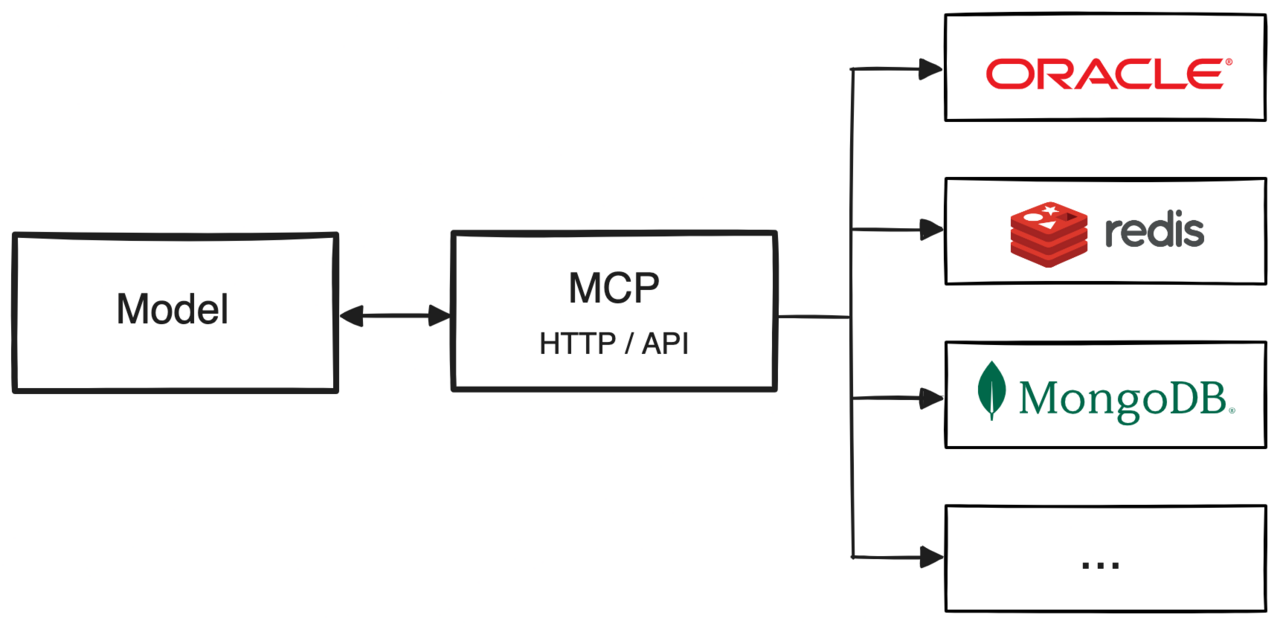
The future of MCP is full pipelines with dynamic content transformation and filtering. Wrapping a single document collection as a tool may seem like overkill, but no business wants to hand the keys to its kingdom to non-deterministic models. MCP gives builders centralized auditing, logging, tracing, security and API tokens; the business also wants very fine-grained control. HBase had cell-level access control lists for a reason. For MCP calls, that control comes from dynamic pipeline filtering:
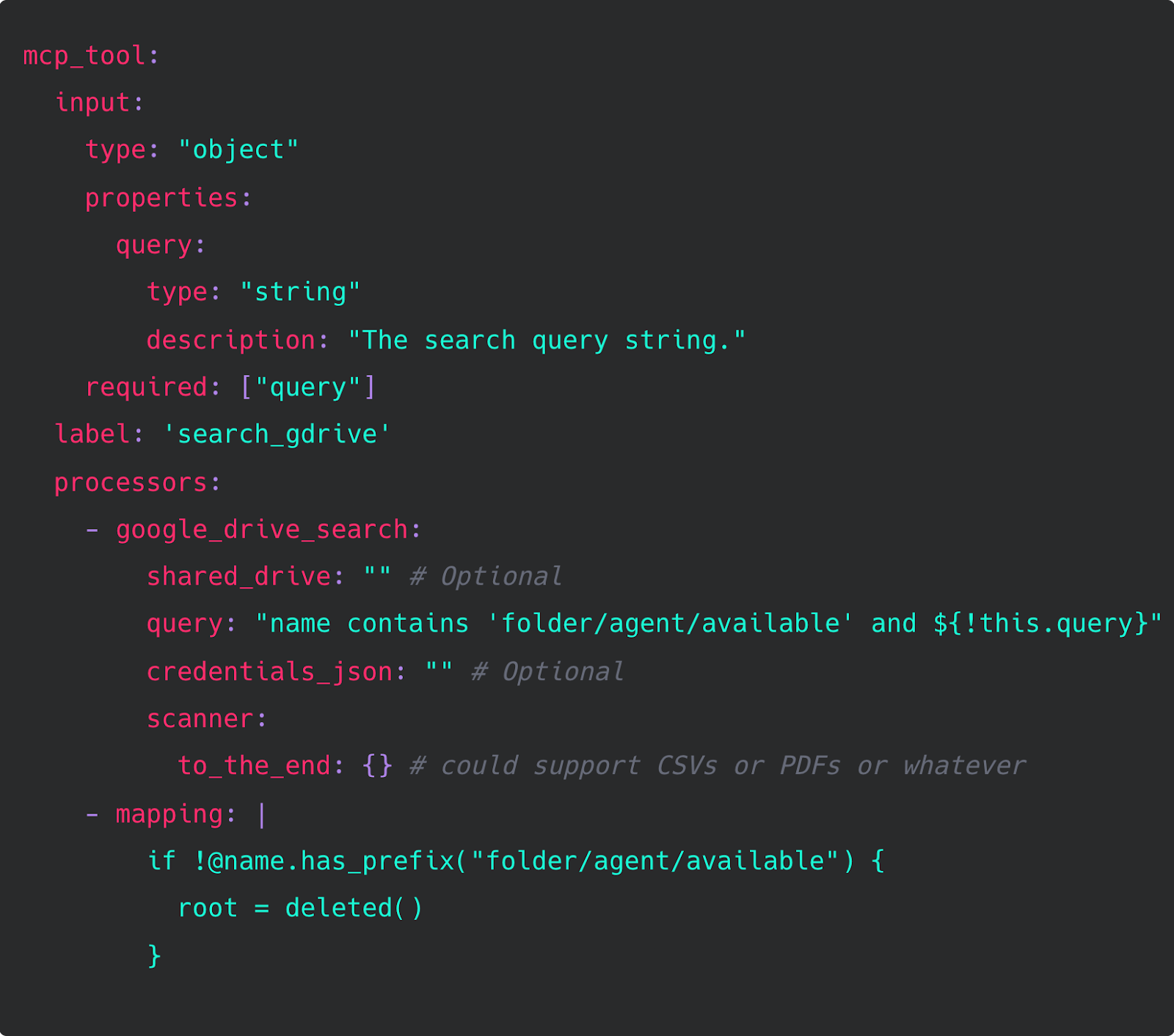
With Redpanda Connect, engineers can use full programming languages through custom code extensions to iterate quickly, while the security team enforces overriding global policies across any of the roughly 300 connectors, declaratively. Governed connectivity of this kind is what the MCP Gateway now provides.
Private data stays in your cloud
Enterprises don't want to share their private data with anyone, the Global 2000 least of all. There will be exceptions that allow data outside the firewall, but they are not the norm.
Six years ago, Redpanda spent a year writing the first version of its cloud, then threw it away and wrote it again, which led to what it calls BYOC. The decision was controversial at the time because it meant not charging extra to resell cloud infrastructure, only for the value of the software. In a small way, it helped change how infrastructure is delivered and consumed.
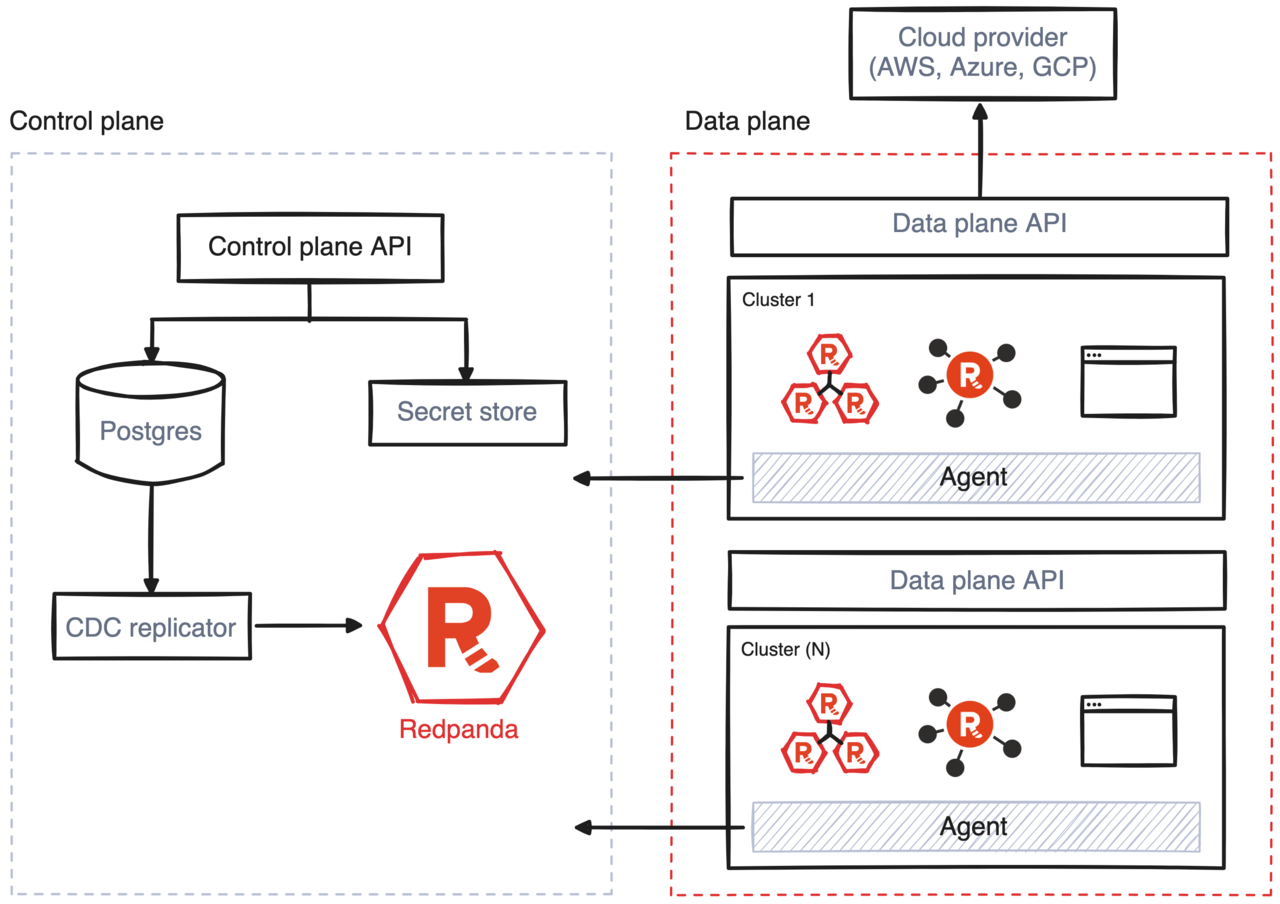
The goal was one deployment model to build on for years that would meet the strictest security and compliance requirements. The core idea was data plane atomicity: no deployment should be able to bring down any other, including during a control plane outage. Failures on every data plane are independent for the data path while the service stays fully managed. There is no externalized consensus, secret manager, external database, offset-recording service or metadata lookup in the way of writing data durably to disk. At worst you can't click through an upgrade, but the data path stays up, and nobody gets paged at 3 a.m.
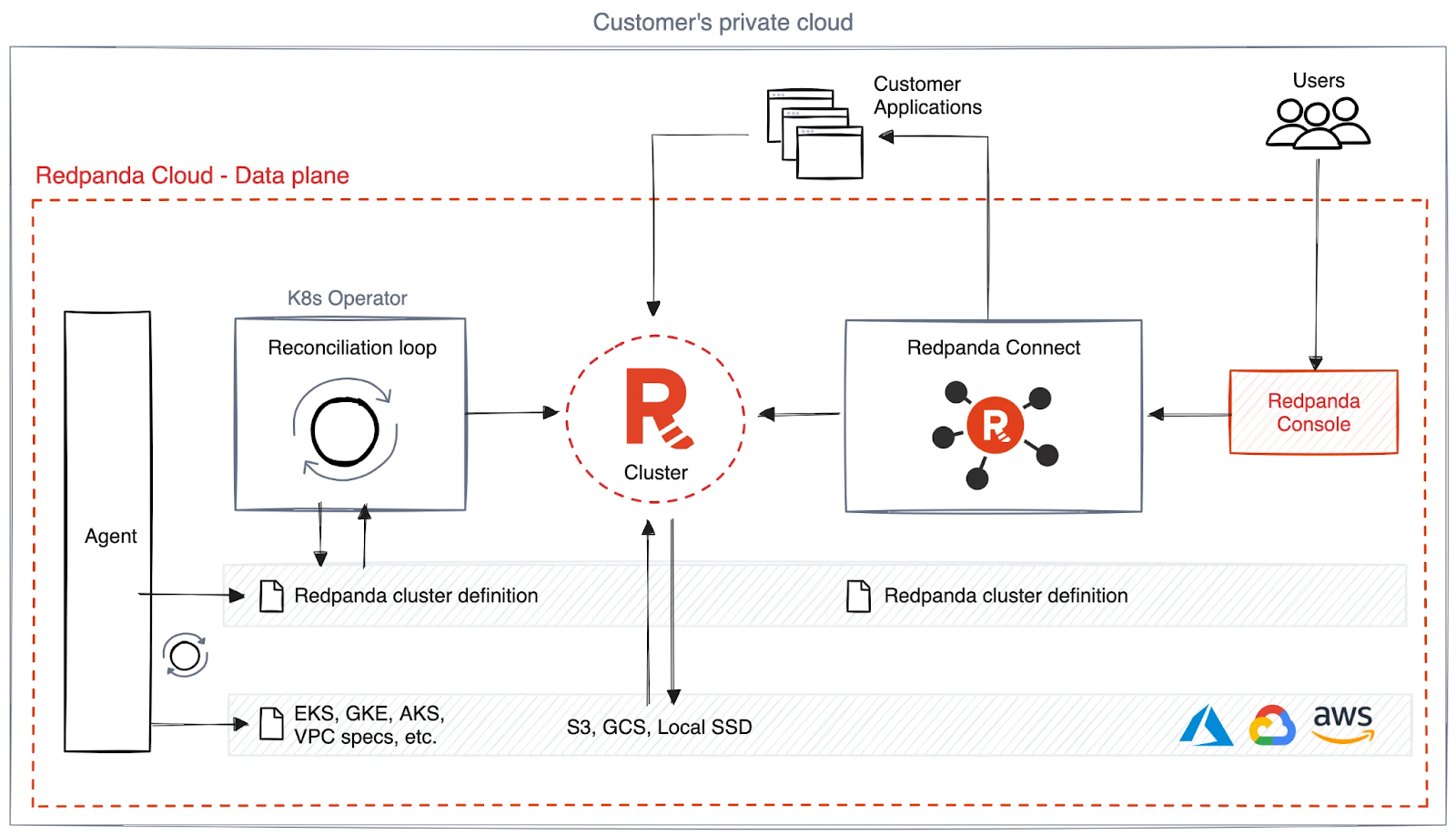
Because the data plane already runs inside the customer's network, it is also the natural place to connect internal applications through Redpanda Connect's portfolio of connectors.

Try it
The framework runs across BYOC deployments on three clouds, with Redpanda Serverless extending that reach. To try the agent tooling:
- Upgrade Redpanda (for example
brew upgrade redpanda) and update the Connect plugin:rpk connect upgrade - Create a demo project:
mkdir demo && rpk connect agent init . - Run it:
rpk connect agent run
This work was fueled in part by the $100 million Series D, with thanks to Muni at GV and Arif at Lightspeed for their support from the start, and to the community of builders who keep building with Redpanda. To see where the thinking began, watch the original Streamcast on Redpanda Agentic AI. The Agentic Data Plane is where the thesis landed: governed connectivity, durable agent-to-agent communication and BYOC deployment for sensitive workloads.
Autonomy only works in the enterprise if private data stays private. That means sending models to the data, mediating every tool call through an intent-based layer like MCP, and keeping the log of what agents did inside your own cloud.
Signals shortlist
- Differential dataflow (Microsoft Research)
- DBSP: automatic incremental view maintenance (arXiv)
- Minions: cost-efficient collaboration between on-device and cloud models (arXiv)
- Adapted from Alex Gallego's post of April 3, 2025; product names and preview status reflect that release.
- CybSafe study on workers sharing sensitive information with AI tools.
- CIDR 2015 paper (source of the log quotation); minion-style delegation paper (arXiv).
Ground Truth is written and edited by Redpanda and invited contributors. Research methodology and sources are listed in each story.