

R2: The engine of engines
The foundation every Redpanda data product will run on


Easier disaster recovery failover and greater flexibility in cloud storage


Redpanda Streaming 26.3 is all about adaptability without sacrificing availability. Shapeshifting lets you change cluster form to fit whatever the moment demands. When the moment demands shifting workloads to different deployments, Fencing supports redeployment without client coordination by limiting access during maintenance or failover operations.
Around those two themes, 26.3 brings faster client recovery, smoother consumer rebalancing, stronger governance and security, and a solid round of Redpanda Connect improvements. Here's what's new.
Shadowing gives you an offset-preserving, continuously updated replica of your cluster in another region or cloud. In 26.3, we’ve added capabilities that make failover seamless during an actual incident.
Promotion and fencing. Promoting a shadow cluster to primary is only half the job. The other half is making sure the old primary can't keep accepting writes if it comes back. With promotion and fencing, Redpanda promotes the shadow and fences the former primary, so you never end up with two clusters each believing it's in charge. No split-brain, no divergent data to reconcile afterward.
Link-based failover. Instead of failing over shadowing operations separately, you fail over an entire shadow link in one operation. Topics, consumer groups, and other configurations covered by that link move together. During an outage, that means one decision and one command, not a runbook with dozens of steps.
Together, these turn disaster recovery from a plan you hope works into a drill you can run on a Tuesday afternoon. Test it, time it, and know your recovery time before you ever need it.
Tiered Storage v2 (TSv2). With Tiered Storage, hot data stays on fast local disks while older data moves to object storage automatically, so you can keep far more history at a fraction of the cost and size clusters for throughput rather than retention. Redpanda Streaming 26.3 makes it easier to reshape workloads on the fly. Users can now migrate in-place existing topics to our next-gen storage engine that supports both fully object-storage-backed Cloud Topics and traditional Tiered Storage. With TSv2, you can now seamlessly shift topics between Tiered Storage and Cloud Topics to adapt to changing workload requirements that balance cost and performance (latency).
Full compaction support for Cloud Topics. We’ve also added full compaction support for topics stored in object storage, retaining only the latest value for each key across the entire partition, and removing tombstone records after the desired retention period. While object storage is cheap, it isn’t free. Tiered Storage v2 helps you keep cloud storage spend down.
Leaderless Cloud Topics. Cloud Topics write directly to object storage, and a leaderless design lets a broker in any availability zone (AZ) accept writes for a topic. For cost-sensitive, high-volume workloads, that means no more cloud networking costs for ingress, fewer cross-zone hops, and simpler scaling.
Two upgrades make clients recover faster when the cluster changes underneath them.
Broker-based consumer group rebalancing (KIP-848). Redpanda now supports the next-generation consumer group protocol, where the broker coordinates group rebalances instead of the clients. Consumers no longer stop the world every time a member joins or leaves, or when topics or partitions are added. Rebalances are incremental, faster, and far less disruptive for large groups, supporting higher scale and minimizing consumer lag. Modern Kafka clients that use the new protocol work with Redpanda automatically when enabled at the cluster level.
Faster leader discovery (KIP-951). When partition leadership moves, Redpanda tells producers and consumers who the new leader is right in the produce and fetch responses. Clients skip the extra metadata round trip and get back to work sooner. The result is lower tail latency during leadership changes, upgrades, rolling restarts, and failovers.
Both features follow KIPs, reaffirming Redpanda’s commitment to Kafka protocol compatibility.
Schema GUIDs and the header-based wire format. Producers can now identify a record's schema with a globally unique identifier (GUID) in a record header instead of an integer ID at the front of the payload. Redpanda handles these records end to end: Schema Registry resolves the GUID, Iceberg topics translate the records into tables, and server-side schema ID validation checks them at the broker. Producers that still use the integer ID keep working with all three, so you can move them over one at a time, without a coordinated cutover.
Extended signing algorithms for OAuth/OIDC. Kafka API authentication with OAuth and OpenID Connect (OIDC) now supports a wider set of token signing algorithms. That makes it easier to plug Redpanda into your existing identity provider and meet stricter security policies without workarounds. We have supported RS256 to date. With 26.3, we are adding RS384 and RS512, as well as ECDSA algorithms: ES256, ES384, and ES512.
Redpanda Connect gets a round of upgrades for teams moving serious data and building their own components.
--rpc-plugins flag now works with the lint, test, and dry-run commands. Custom plugins get the same fast feedback loop as built-in components.Under the hood, expanded connector test coverage means more confidence in every connector you deploy.
Redpanda Connect pipelines are now GA. The Pipeline custom resource, introduced as beta in 26.2, is ready for production. It runs Redpanda Connect pipelines as declarative, GitOps-friendly Kubernetes workloads. You turn it on with one Helm setting on your existing operator, so there’s no separate operator to install. The operator lints each configuration before startup, rolls the pipeline whenever its configuration or credentials change, and injects broker addresses, TLS material, and SASL credentials from a referenced cluster. Pipelines also support kubectl scale, HPA, or KEDA, so you can autoscale on consumer group lag.
Gateway API external access is now GA. TLSRoute-based external access lets clients reach your cluster through a single Gateway API entry point instead of per-broker LoadBalancers or NodePorts. The Gateway routes each connection to the right broker by SNI hostname, and you choose TLS passthrough or termination. Listeners opt in one at a time with type: tlsroute, so you can migrate from existing Services gradually, without a cutover.
From StatefulSets to Broker resources (beta). The Redpanda Operator is moving off Kubernetes StatefulSets to a dedicated Broker custom resource. Each broker becomes a first-class object the operator manages directly. That gives you finer control over individual brokers, safer rolling changes, and more predictable scaling and node replacement, without fighting StatefulSet's one-size-fits-all ordering rules. This is available as a beta feature in v26.3.x. Share feedback on the Broker custom resource to redpanda-data/community on GitHub.
Skip-version upgrades. Move from an older Redpanda release straight to the latest without stepping through every version in between. Shorter maintenance windows, less upgrade toil. This feature, now available in 26.3, allows skip-level upgrades to clusters running release 26.2 and above. Note that users will still need to do step-wise upgrades to reach version 26.2 before you can take advantage of this feature.
Want the full list of changes? Head over to our release notes or check what's new in Docs.
Fencing means you've already rehearsed the hard moments. Shapeshifting means your platform can change with you instead of holding you back. Redpanda Streaming 26.3 delivers both, along with smoother maintenance windows, improved schema management, greater GitOps friendliness, and a refined Redpanda Connect.
Want to see it in action? Book a demo below and we'll walk you through a failover drill of your own.
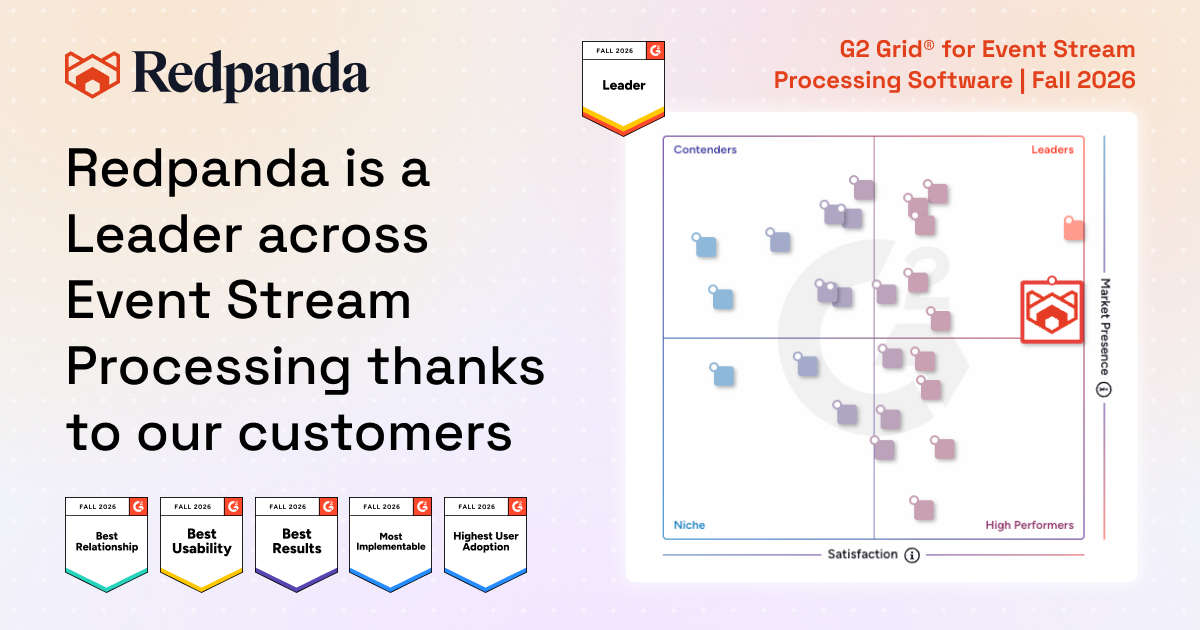
Redpanda ranked #1 in implementation, usability, results, and relationship indexes
Redpanda Shadowing now carries topic data, schemas, offsets, and ACLs on a single link for a low-risk, no-data-loss cutover
Subscribe to our VIP (very important panda) mailing list to pounce on the latest blogs, surprise announcements, and community events!
Opt out anytime.