



Why agentic AI pilots stall before production
Why the demo worked but the rollout didn’t—and what you need to successfully scale agents


Make sure you’re buying actual agent governance, not lock-in


Agentic governance is the difference between agents in production and agents stuck in permanent pilot. But the true blocker to agentic enterprise AI isn’t technology, budgets, or organizational mandates. It’s a much simpler, much harder question: how do we control these things?
Every major platform vendor will tell you they’ve already solved it. For the CIO deciding whether to trust any of them, the question isn’t whether a vendor’s governance works, it’s whether you still own it when you need it most.
The six questions below come straight from what actually breaks when a vendor’s governance stops at the edge of their own platform.
Every major platform vendor will offer to govern your agents. Read the offer carefully. They’ll govern their agents, inside their garden, with policies that live in their console and evidence that stays in their cloud.
Turns out the governance the vendor provides is real, but only up to the garden wall. Step outside it, to the other framework your teams already use, the other cloud your acquisition brought, the better model that ships next quarter, and governance disappears.
Governance you can’t take with you is lock-in masquerading as compliance, and it converts your control layer into a vendor’s retention strategy.
Open standards make freedom from walled gardens possible. MCP for tools, OAuth for identity, A2A for agent traffic, OpenTelemetry for evidence. Building governance on open standards lets a single layer cover every agent you run, regardless of who built it, where it lives, or what model, framework, or cloud you use.
Portability also changes what agent adoption looks like.
You don’t have to go all in on day one. The control layer governs the two agents you have now and the 20,000 you’ll have later, with each additional agent inheriting the same controls. And it preserves the most important freedom of all: you can walk away. If you move on, your policies and your evidence travel with you.
A governance layer you can exit is the only kind you can trust: trust comes from structure, not promises. That applies to vendors too.
A vendor who resents these questions just answered them.
Question 4 is the one vendors most often fudge. Here’s what “depends on the agent’s cooperation” looks like in practice. Vendors typically try one of three fixes, and all three share the same flaw: they live inside the agent’s own channel.
Every fix fails in the same place: identity, prompt rules, and guardrail models all depend on something the agent reads or reports. That’s what “out-of-band” is actually checking for.
The six questions above tell you what to ask a vendor. The six components below tell you what to actually check for when they answer.
If a platform doesn’t do all six, it isn’t a governance platform you can trust with production data. A platform that passes all six questions and covers all six components is one your agents can scale on. A platform that doesn’t is one you’ll outgrow, and find out the hard way what lock-in actually costs.
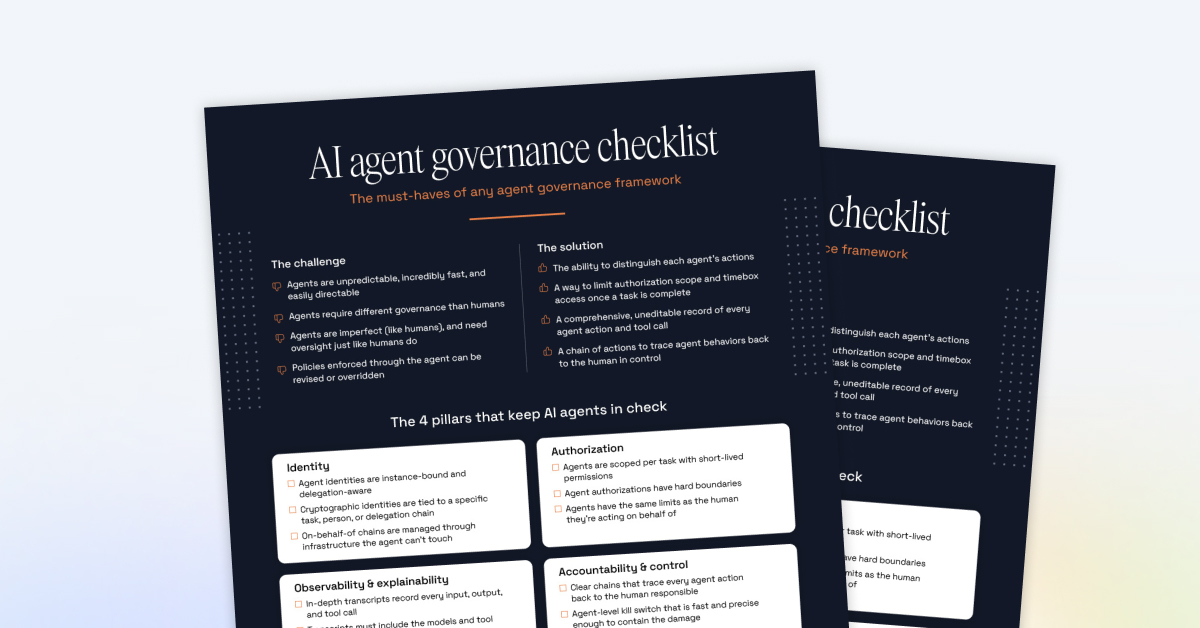
If you want a handy checklist that summarizes everything above, grab your free cheat sheet below.
{{featured-resource}}
A vendor can answer all six questions well in a sales call. The six components are how you verify the answers hold up once the contract is signed. If a platform passes the questions but is missing even one of the components, pressure-test it: the gap is usually exactly where “it depends on the agent’s cooperation” sneaks back in.
The firms that get this right end up with agents they can actually scale, because the governance travels with every new agent, every new model, every new cloud they add. The ones that don’t find out the hard way what lock-in actually costs, usually at the worst possible time: mid-migration, mid-audit, or mid-incident.
Want the full breakdown of what a governance layer has to do, and what every seat in the C-suite owns in building it? Download the Redpanda Handbook to Agentic AI Governance.
Why the demo worked but the rollout didn’t—and what you need to successfully scale agents

Good intentions don’t work. Mechanisms do.
What two security operators learned from a decade of building at petabyte scale
Subscribe to our VIP (very important panda) mailing list to pounce on the latest blogs, surprise announcements, and community events!
Opt out anytime.