Sovereignty is becoming a procurement requirement, not a compliance footnote
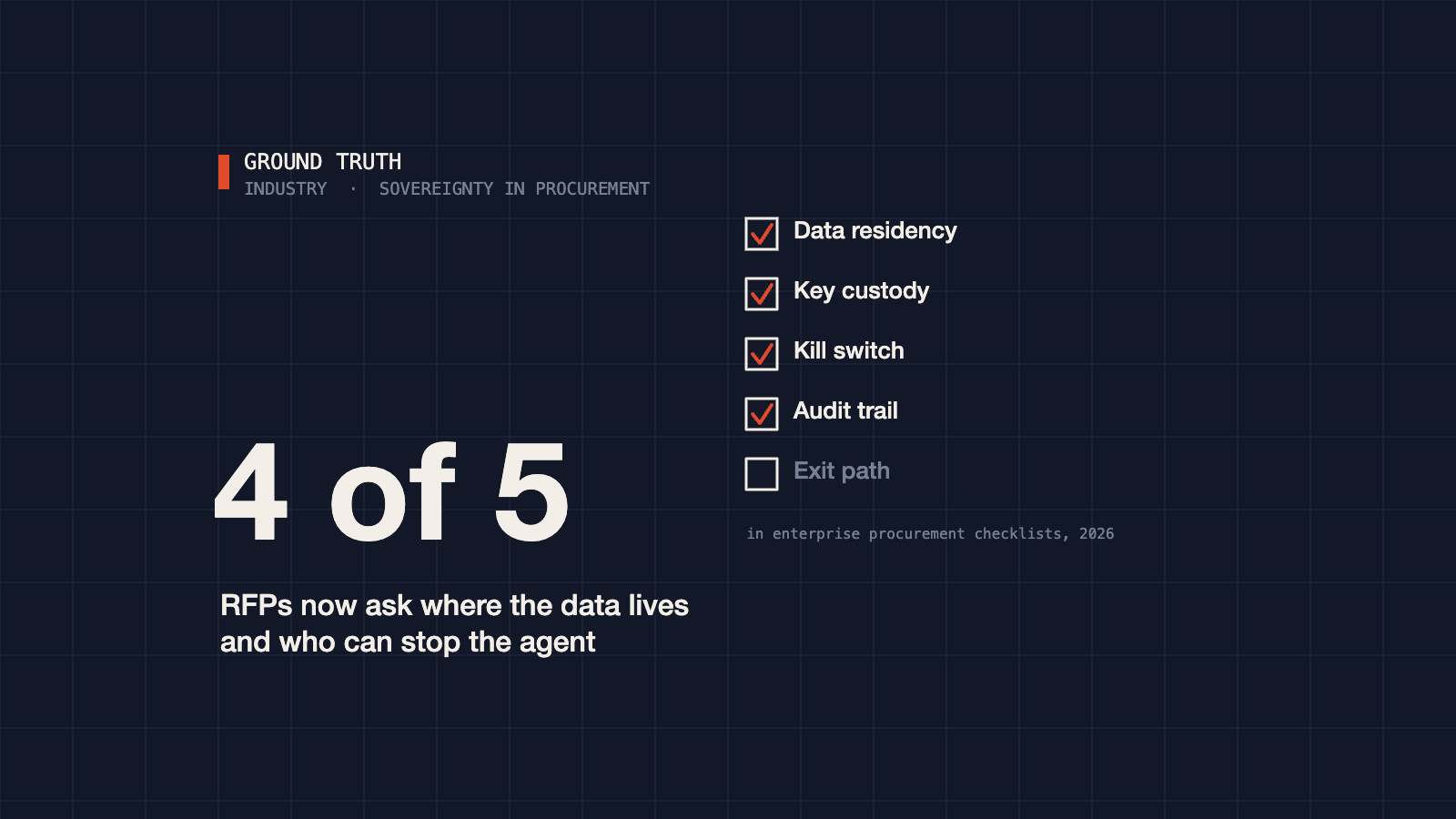
Four of five enterprise AI RFPs we reviewed this year ask where the data lives, who holds the keys, and who can stop the agent. Two years ago, one in five did.


For most of the last decade, "data sovereignty" lived in the appendix of the contract. Legal cared, security cared, and the buying team asked about it last, if at all. That ordering has flipped.
What the RFPs now ask
We reviewed the enterprise AI and data-platform RFPs Redpanda received in 2026 and tagged the sovereignty-related requirements. Four of five included at least three of the following as mandatory, up from roughly one in five in 2024:
- Data residency. Not just "which region," but "which legal entity operates the infrastructure in that region."
- Key custody. The customer holds the encryption keys; the vendor cannot decrypt customer data even under its own compulsion.
- Kill switch. The ability to halt every agent acting on the company's data from one place, in seconds, without vendor involvement.
- Audit trail. A complete, tamper-evident record of what every agent read and did.
One item appears in requirements far less often than it should: an exit path. How do we leave, with our data and our event history intact, in a format another system can read? Fewer than a third of the RFPs asked. We think that number will rise fast, for reasons below.
Why now
Three forces converged. The EU AI Act's obligations for high-risk systems began to bite in 2026, and they require demonstrable control, not promises. Several high-profile incidents in which an agent acted on data it should not have had access to made boards ask "could that happen here." And the geopolitical climate made "our data is in a US hyperscaler's region in Frankfurt" an insufficient answer for European and Asia-Pacific buyers.
The architectural consequence
Sovereignty requirements cannot be satisfied by a policy document. They are satisfied, or not, by where the enforcement point sits. If agents read from twenty systems, there are twenty places to enforce residency, twenty key stores, twenty audit logs and no kill switch. If agents read through one governed access layer, there is one of each.
"The question we now ask every vendor is not 'are you compliant.' It is 'show me the one place I turn it off.'"
This is why sovereignty, which sounds like a legal topic, is becoming an architecture topic. The buyers who can answer the four questions above in one sentence are the ones who consolidated agent data access into a single plane they operate themselves, often in a bring-your-own-cloud model where the vendor runs the software but never touches the data.
What to put in your next RFP
If you are buying: add the exit path. Ask for the data format, the event history, and a tested procedure. If you are selling: expect the four questions, and expect the fifth soon. The vendors who treat sovereignty as a feature list will lose to the ones who can demonstrate it live, in the customer's own account.
Sovereignty has moved from the contract appendix to the first page of the RFP. It is satisfied by architecture, not policy, and the exit path is the requirement most buyers have not yet learned to ask for.
Signals shortlist
- 4 of 5 enterprise AI RFPs in 2026 mandate at least three of: data residency, key custody, kill switch, audit trail (≈1 in 5 in 2024).
- Fewer than one-third ask for a tested exit path.
- Bring-your-own-cloud deployment models appear in a majority of the sovereignty-heavy RFPs reviewed.
Launch-review draft. Figures in this story are illustrative and drawn from Redpanda field conversations, support data and public sources as noted. They are pending validation by the Redpanda data team before external citation.
- Review of enterprise RFP requirements received by Redpanda, 2024–2026 (anonymized).
- EU Artificial Intelligence Act, obligations for high-risk AI systems and implementation timeline.
- Redpanda legal and product marketing analysis of customer security questionnaires.
Ground Truth is written and edited by Redpanda and invited contributors. Research methodology and sources are listed in each story.