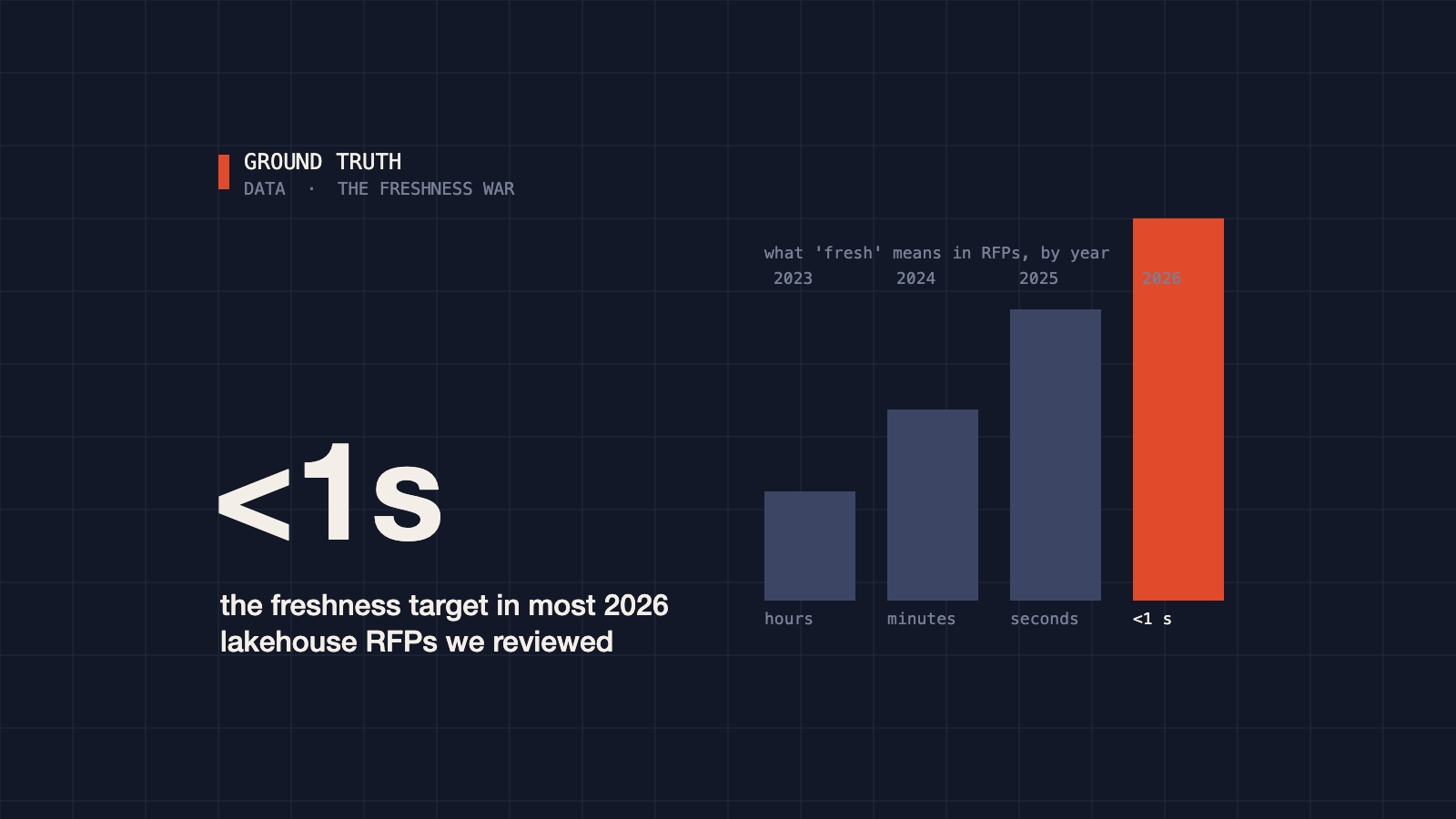
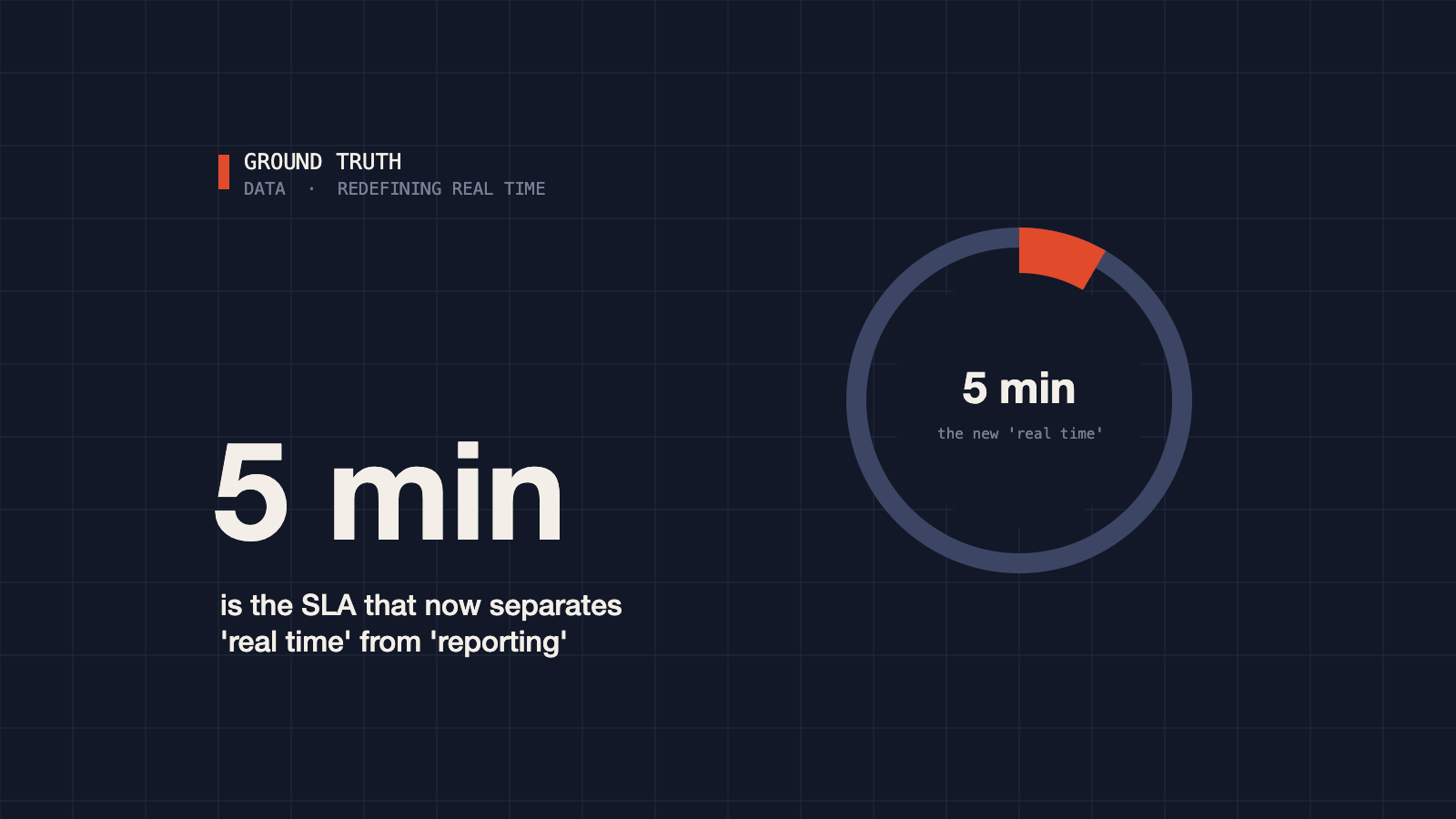
'Real time' now means five minutes. Anything slower is reporting.
We asked buyers what they mean when they say real time. The answer has converged on a hard line: under five minutes is operational, over five minutes is a report. Most data stacks sit on the wrong side of it.


"Real time" has been the most abused phrase in data for twenty years. Vendors used it to mean anything from microseconds to overnight. Buyers nodded along because nobody had a reason to pin it down.
In 2026, buyers have a reason, and they have pinned it down.
The five-minute line
In conversations with data and platform leaders this year, we started asking a blunt question: at what latency does data stop being useful for action and become useful only for understanding? The answers clustered tightly. Under five minutes, people described the data as something they would act on: route a truck, hold a payment, adjust a price, let an agent proceed. Over five minutes, they described it as something they would look at: a dashboard, a report, a retrospective.
Five minutes is not a technical constant. It is roughly the time in which a customer notices, a competitor reacts, or a fraudulent transaction clears. It is the edge of consequence.
Why most stacks are on the wrong side
Most enterprise data flows still run in hourly or fifteen-minute batches, with a "fast path" bolted on for one or two use cases. When we asked teams to estimate what share of their operational data crossed the five-minute line, the median answer was under 20%. The rest is reporting, whether or not anyone calls it that.
This was fine when the consumers were people reading dashboards. It is not fine when the consumers are agents making decisions, and that is the shift forcing the issue.
What's different about the teams above the line
- They stopped building fast paths. Instead of a special pipeline for the urgent data, the default pipeline is streaming and batch is the exception.
- They measure age, not throughput. The dashboard metric is "how old is the newest row," watched like uptime.
- They put the line in the SLA. Internal data products carry a freshness commitment, and anything over five minutes is labeled as a report, deliberately.
"Calling something 'real time' used to be marketing. Now it's a contractual promise with a number attached, and the number is five minutes."
What to do with this
Inventory your data products and sort them by the age of their newest row. Everything over five minutes is a report; label it that way. Then look at what sits in the report pile that someone, or some agent, is actually using to act. That list is your streaming roadmap, and it is probably longer than you think.
Buyers have drawn a hard line at five minutes between data you act on and data you look at. Most enterprise data lives on the reporting side, and agents are what will force it across.
Signals shortlist
- Buyer definitions of "real time" cluster under five minutes; above that, data is treated as reporting.
- Median share of operational data crossing the five-minute line: under 20%.
- Teams above the line default to streaming and label batch outputs explicitly as reports.
Launch-review draft. Figures in this story are illustrative and drawn from Redpanda field conversations, support data and public sources as noted. They are pending validation by the Redpanda data team before external citation.
- Redpanda developer advocacy and customer conversations on freshness expectations, 2026.
- Redpanda field survey of data-platform leaders on operational versus analytical latency.
- Public case studies on streaming-first data platform migrations.
Ground Truth is written and edited by Redpanda and invited contributors. Research methodology and sources are listed in each story.