Every data team is becoming a platform team. The stream is why.
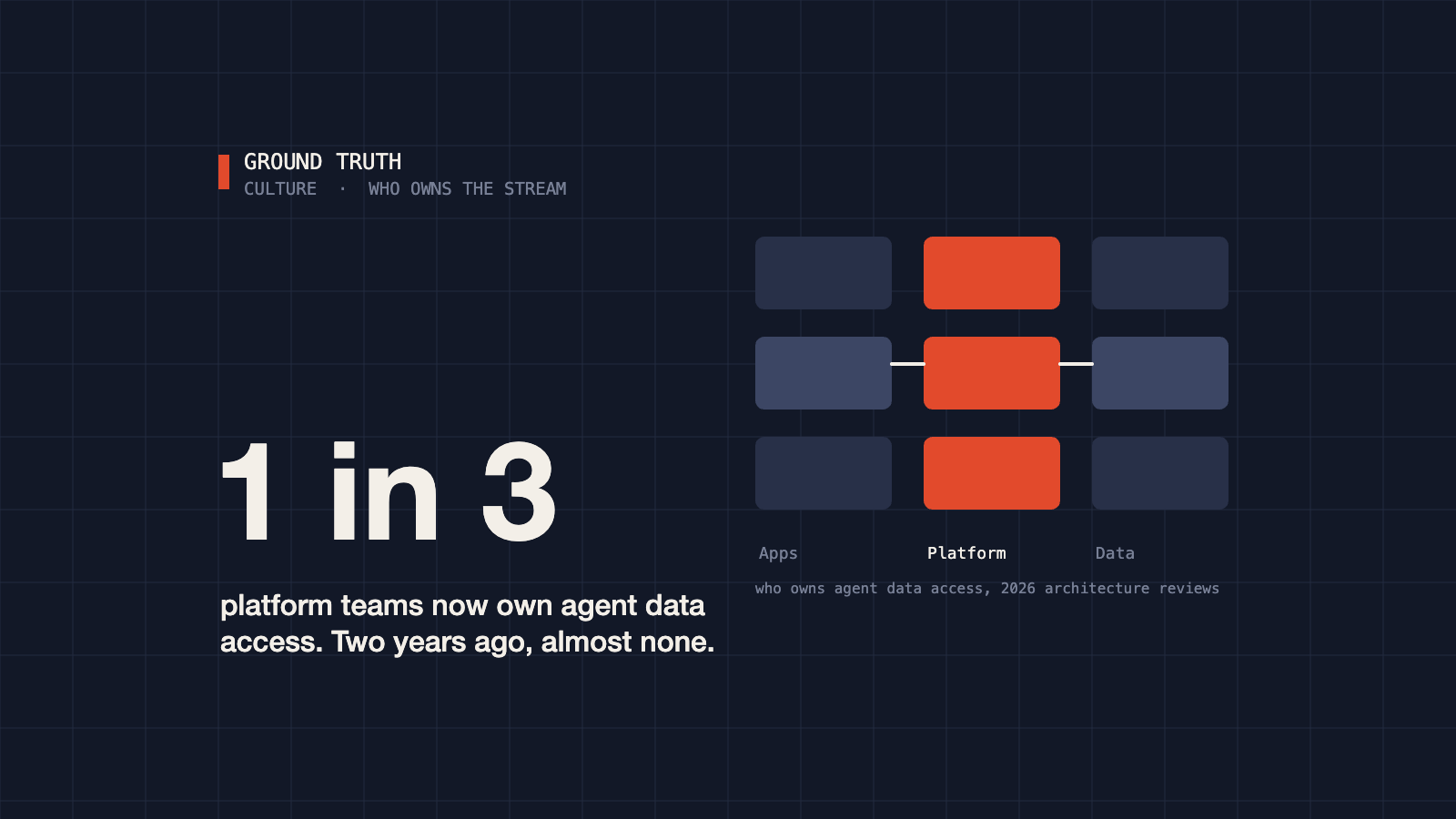
Across 200 architecture reviews this year, one in three platform teams now own agent data access. Two years ago almost none did. The org chart is quietly reorganizing around the stream.


Ask who owns the data in a large company and you used to get a clean answer: the data team. They ran the warehouse, wrote the pipelines, published the dashboards. Application teams produced data; the data team consumed it; nobody else needed to care about the plumbing in between.
That answer is breaking down, and the reason is the stream.
What 200 architecture reviews showed
In the architecture reviews Redpanda ran with enterprise customers this year, we started tagging one thing: which team owned the layer that agents and applications read operational data from. The result surprised us. In roughly one in three organizations it was the platform team, not the data team. Two years ago that number was close to zero.
Something structural is happening. The stream used to be a pipe between applications and the warehouse. It is becoming the place where live state lives, where agents read from, and where access is enforced. That makes it infrastructure, and infrastructure belongs to platform.
Three signs the shift is underway in your org
- The data team is asking for SLAs, not schemas. When analysts start caring about freshness and uptime rather than column names, the system they depend on has become operational.
- Application teams are publishing events, not tables. The contract between producers and consumers moved from "here is a nightly extract" to "here is a topic."
- Someone has written down who can read what. Access control at the stream, with an owner, is the clearest sign that the layer has graduated from pipeline to platform.
Why this is a culture story
Reorganizations around technology rarely go smoothly, and this one has a particular friction: data teams built their identity on being the source of truth, and platform teams are not used to being asked about business semantics. The organizations handling it best are not picking a winner. They are splitting the job: platform owns the stream's availability, latency, security and cost; data owns what the events mean and who should see them.
"We stopped arguing about who owns the data and started agreeing on who owns the plumbing and who owns the meaning. The meeting got a lot shorter."
What to do if you are leading one of these teams
If you lead data: get your freshness and access requirements into the platform roadmap now, in writing, before agents make them urgent. If you lead platform: expect the stream to land in your portfolio, budget for it like a database, and bring the data team in early on governance. If you lead both, congratulations, you are already where most organizations will be in two years.
The stream is graduating from a pipeline to a platform, and ownership is following it. The teams that split "plumbing" from "meaning" cleanly are the ones avoiding a turf war.
Signals shortlist
- 1 in 3 platform teams own agent data access in 2026 architecture reviews; close to zero in 2024.
- Freshness and uptime SLAs now appear in data-team requirements more often than schema requests.
- Topic-based producer contracts are replacing nightly extracts in a majority of reviewed organizations.
Launch-review draft. Figures in this story are illustrative and drawn from Redpanda field conversations, support data and public sources as noted. They are pending validation by the Redpanda data team before external citation.
- Redpanda enterprise architecture reviews, 2026, tagged by owning team of the data access layer.
- Redpanda developer advocacy and product marketing conversations with platform and data leaders.
- Public talks and posts on platform-team ownership of streaming infrastructure.
Ground Truth is written and edited by Redpanda and invited contributors. Research methodology and sources are listed in each story.